

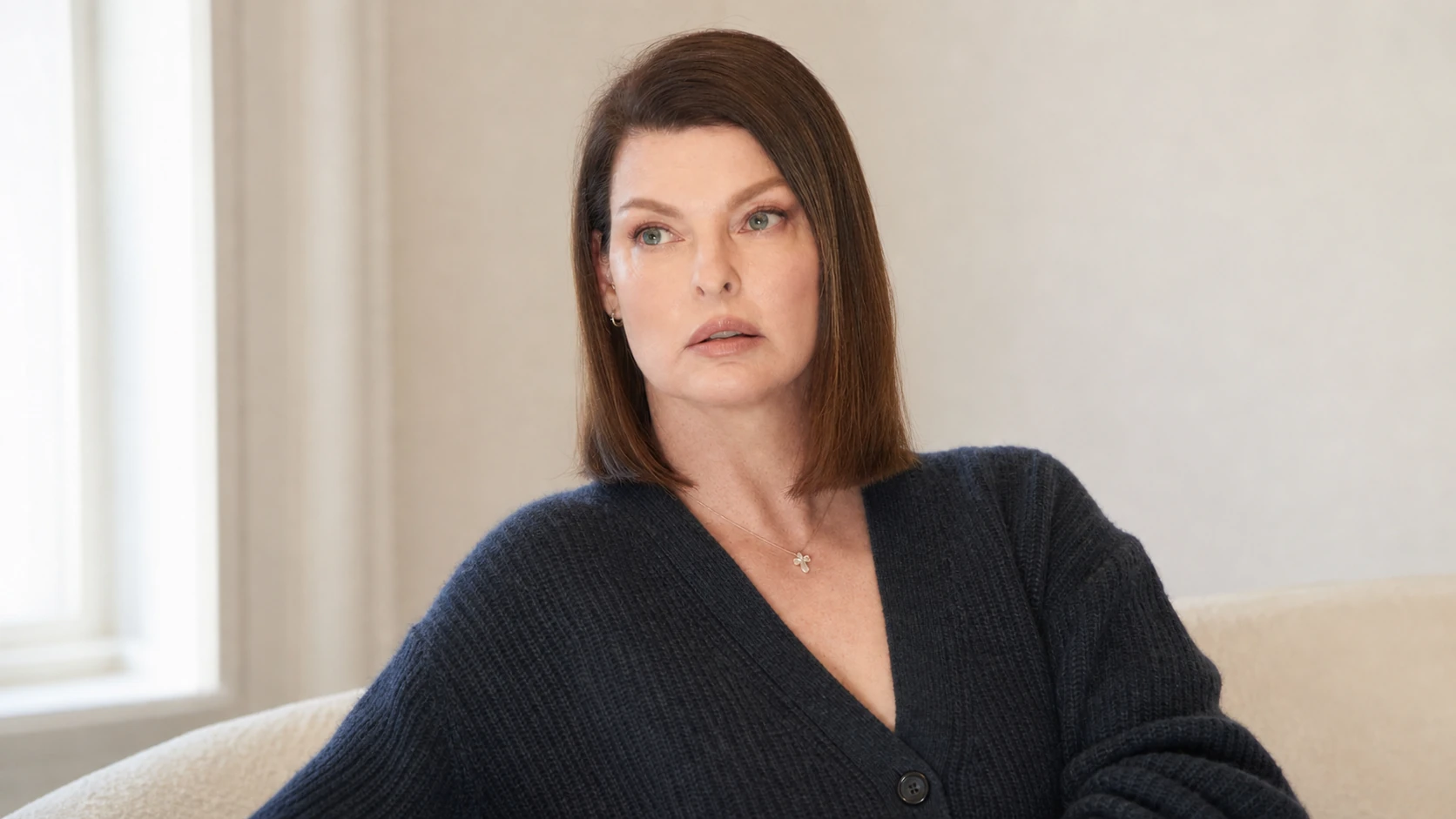
Linda Evangelista built her career by transforming in front of the camera. During the peak of the supermodel era, she became famous for changing her hair, mood and visual identity from one assignment to the next, appearing on hundreds of magazine covers and working with many of fashion’s most respected photographers. Decades later, photographs again became central to her public story, but for a very different reason.
In February 2022, Evangelista allowed People magazine to photograph physical changes she said developed after CoolSculpting treatments. She had spent years largely outside public view before revealing that she had been diagnosed with paradoxical adipose hyperplasia, a rare complication in which treated fatty tissue grows instead of shrinking. The Linda Evangelista CoolSculpting photos became part of a wider account involving repeated medical procedures, lost work, depression and a legal dispute that was later settled privately.
Her life cannot be reduced to that difficult period. Evangelista remains one of the defining models of her generation, a mother, a cancer survivor and a public figure whose return to fashion has unfolded carefully rather than as a simple comeback story.
Early Life and Family
Linda Evangelista was born on May 10, 1965, in St. Catharines, Ontario, Canada. She is 61 years old as of July 2026. She grew up in a Canadian family of Italian heritage and has spoken about being raised in a close household far removed from the major fashion centers where she would later work.
Her interest in modeling began while she was still young. As a teenager, she attended modeling classes and entered the Miss Teen Niagara beauty pageant. She did not win the competition, but the exposure helped connect her with representatives from the modeling industry.
Evangelista eventually moved to New York and signed with Elite Model Management. Her early career followed the demanding route common to international models: castings, test photographs, travel and repeated efforts to establish relationships with magazines, designers and photographers. She later worked extensively in Paris and other fashion capitals, building the professional range that would separate her from models known for only one type of look.
Career Breakthrough
Evangelista’s rise accelerated during the second half of the 1980s. She became closely associated with photographer Steven Meisel, whose work helped shape her public image across editorials, advertising campaigns and magazine covers. Their creative partnership lasted for decades and became one of the most recognizable photographer-model collaborations in modern fashion.
A major turning point came in 1988, when hairstylist Julien d’Ys cut Evangelista’s long brown hair into a short style. Some clients initially canceled bookings because the change was considered too dramatic. Within months, however, the haircut became widely copied and helped establish her reputation as a model who could transform herself rather than protect one fixed commercial appearance.
That adaptability became her signature. Evangelista changed her hair color repeatedly, moving between dark brown, platinum blonde and red while taking on different characters for each shoot. Fashion editors valued her ability to understand the purpose of an image and deliver more than conventional beauty.
The Supermodel Era
By the beginning of the 1990s, Evangelista was part of a small group of models whose fame extended beyond the fashion business. She was commonly linked with Naomi Campbell, Christy Turlington, Cindy Crawford and Tatjana Patitz, all of whom appeared in George Michael’s 1990 music video for “Freedom! ’90.” The video strengthened the idea that top models had become cultural figures in their own right.
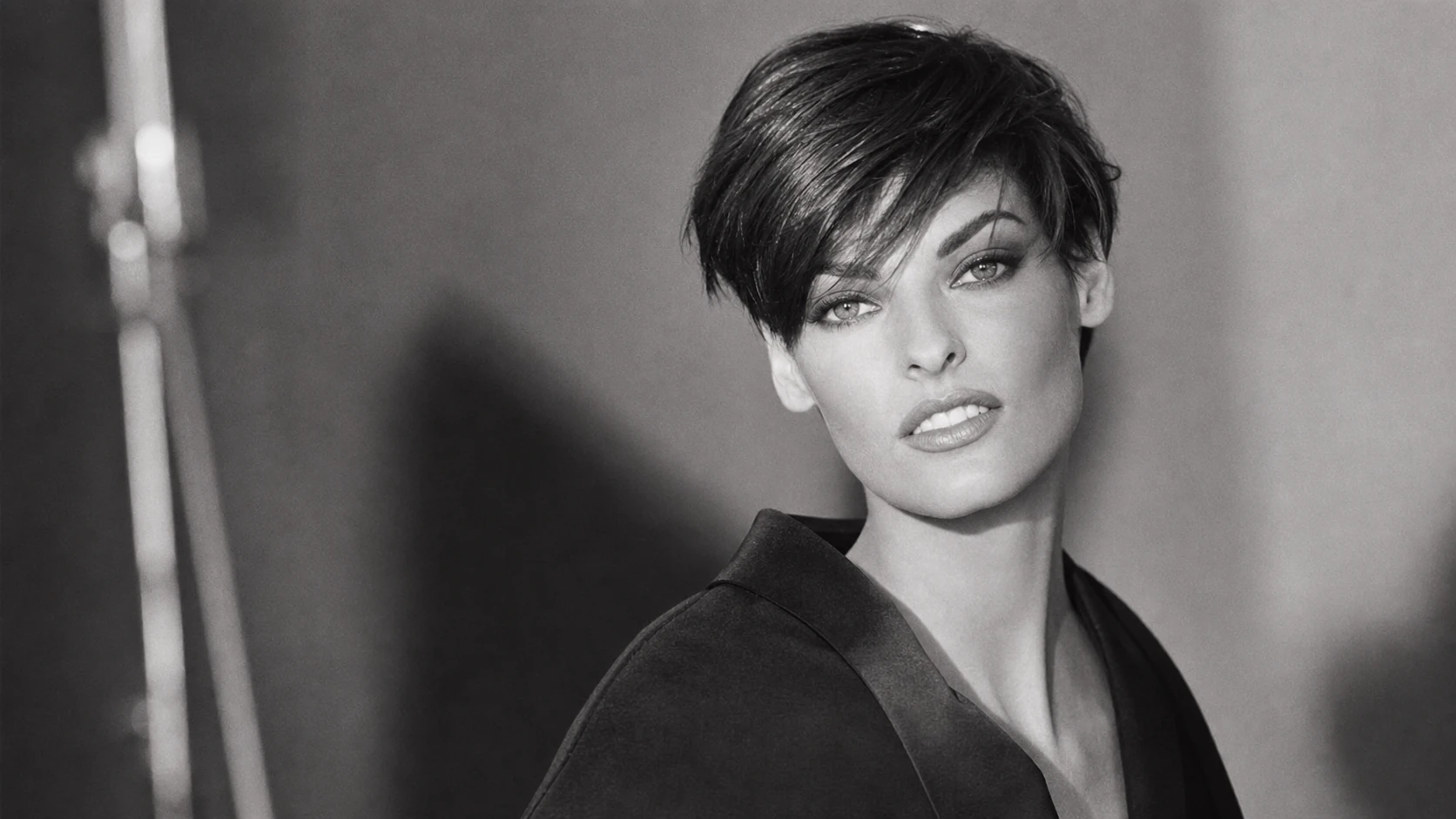
Evangelista also appeared with other leading models on the January 1990 cover of British Vogue, photographed by Peter Lindbergh. The image came to represent the rise of the supermodel: women whose names, faces and personalities could carry campaigns and generate attention comparable to film stars.
Her best-known public remark came from a 1990 interview in which she said that she and other top models did not wake up for less than $10,000 a day. The sentence was repeated for decades, often without the surrounding humor or context, and became a symbol of the wealth and confidence associated with the era. It also showed how closely Evangelista’s public identity had become tied to fashion’s growing celebrity culture.
Across her career, she worked for major designers and beauty companies, appeared on numerous international magazine covers and participated in campaigns that helped define the visual style of the late 1980s and 1990s. Exact career cover totals vary by publication and counting method, but her body of work places her among the most photographed models of her generation.
Marriage, Relationships and Motherhood
Evangelista married Gérald Marie, who was then a senior executive at Elite Model Management, in 1987. Their marriage ended in divorce in 1993. In later years, she publicly discussed painful aspects of that relationship and said she had experienced abuse, allegations Marie denied.
She was later engaged to actor Kyle MacLachlan, whom she met during a fashion-related project. Their relationship ended before they married. Evangelista also had a relationship with French footballer Fabien Barthez.
Her only child, Augustin James Evangelista, was born in October 2006. French businessman François-Henri Pinault was publicly identified as his father during child-support proceedings. Evangelista has generally protected her son’s privacy, and details about his education and personal life are not publicly confirmed.
Motherhood became one of the central parts of her life away from modeling. Although she has discussed some family experiences in interviews, she has not built a public brand around her child or shared his daily life extensively.
CoolSculpting Treatments and Diagnosis
Evangelista said she underwent seven CoolSculpting sessions between August 2015 and February 2016. CoolSculpting is a branded form of cryolipolysis, a non-surgical body-contouring procedure that uses controlled cooling to damage selected fat cells. The body is then expected to clear those cells gradually.
Instead of becoming smaller, several treated areas on Evangelista’s body began to enlarge and harden. She said the changes affected her chin, thighs, abdomen, back and areas near her bra line. At first, she blamed herself and responded by restricting food and exercising more.
A doctor diagnosed her with paradoxical adipose hyperplasia in June 2016. PAH is an uncommon complication in which fatty tissue within the treatment area becomes larger and firmer. The enlargement may take the shape of the applicator and can emerge months after the original procedure.
Evangelista said corrective liposuction did not produce the recovery she expected. She underwent several operations over the following years and later described the affected tissue as hard and physically uncomfortable. She also said the condition changed her posture and caused chafing in some areas.
What the Linda Evangelista CoolSculpting Photos Showed
Evangelista first publicly explained her condition in September 2021. She said she had been left physically altered and emotionally distressed, leading her to withdraw from work and social life. Her statement prompted worldwide coverage, but readers initially had few photographs showing the changes she described.
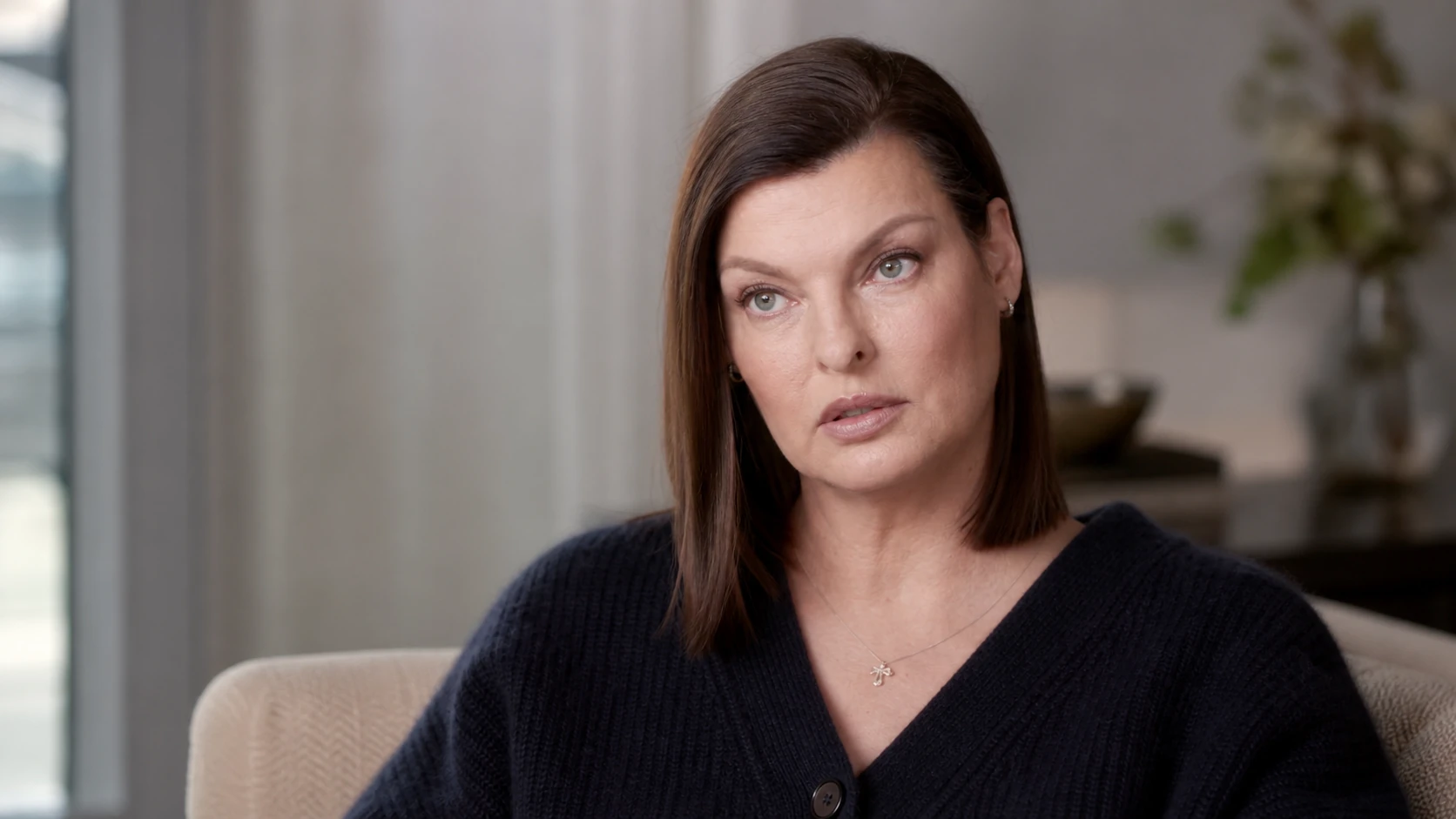
That changed in February 2022, when People published an interview and an editorial photo session. One of the most discussed images showed a firm, rectangular protrusion beneath her arm. She also described enlarged areas around her thighs, chin and torso, though the magazine did not publish a complete medical record of every treatment site.
The photographs were real, authorized images created with Evangelista’s participation. They were not a standardized clinical before-and-after series. Older runway pictures and magazine covers cannot provide a precise comparison because they were taken years earlier under different lighting, posing, clothing and retouching conditions.
The images mattered because Evangelista had spent much of her adult life being photographed under controlled fashion conditions. By showing areas she had hidden, she reclaimed part of the story from speculation and unauthorized paparazzi pictures. She was not presenting herself as a medical case study; she was showing the personal reality behind her absence.
Lawsuit and Private Settlement
In 2021, Evangelista filed a lawsuit against Zeltiq Aesthetics, the company that developed CoolSculpting. She sought $50 million in damages, alleging that the condition had caused permanent injury, emotional suffering and major losses in modeling income.
Zeltiq disputed her claims and argued that the possibility of paradoxical adipose hyperplasia had been included in safety information. Because the dispute ended before trial, a court did not issue a final verdict deciding whether all of Evangelista’s allegations or the company’s defenses were correct.
The parties settled the lawsuit in July 2022. The financial terms and other conditions were not made public. Claims online that identify an exact payment should therefore be treated as unsupported unless credible legal documents are produced.
Return to Fashion
Several months after publishing the CoolSculpting photographs, Evangelista began returning to high-profile fashion work. She appeared in a Fendi campaign and took part in a September 2022 British Vogue cover shoot photographed by Steven Meisel.
She was open about how the cover image had been constructed. Tape and elastics were used to shape the appearance of her face and neck, which she described as part of the fantasy created for the photograph. That disclosure prevented the image from being honestly presented as proof that every physical effect had disappeared.
Evangelista also appeared in the 2023 Apple TV+ documentary series The Super Models alongside Naomi Campbell, Cindy Crawford and Christy Turlington. The series revisited their careers while allowing the women to discuss how fashion, fame and personal experiences had shaped them.
In May 2024, she attended the Met Gala for the first time since 2015. Her appearance was widely viewed as another sign that she had resumed a public role, though she continued to describe recovery as emotionally difficult.
Cancer Diagnoses and Health
Evangelista disclosed in 2023 that she had faced breast cancer twice. She was first diagnosed in 2018 after the cancer was detected through a routine mammogram. She chose to undergo a bilateral mastectomy.
She later discovered another cancerous area in 2022 and received further treatment. Evangelista spoke about approaching the illness with determination while acknowledging that survival statistics and future outcomes could never offer total certainty.
These diagnoses occurred during the same broad period in which she was coping with PAH and corrective procedures. The combination helps explain why her years away from fashion cannot be attributed to a single event.
Net Worth and Income Sources
Linda Evangelista’s exact net worth is not publicly confirmed. Celebrity finance websites publish estimates, but those figures usually lack access to private contracts, investments, taxes, legal costs, medical expenses and property records. They should not be treated as audited facts.
Her documented income sources have included modeling fees, international advertising campaigns, magazine work, fashion appearances and licensing or endorsement agreements. At her career peak, she belonged to a small group of models who commanded unusually high daily rates and long-term commercial contracts.
Her lawsuit claimed substantial lost earnings after the CoolSculpting complication, but the amount requested in a legal complaint does not establish her net worth or prove the final value of her losses. The settlement remained confidential, leaving no verified basis for calculating how it changed her finances.
Recent Work and Current Status
By 2025, Evangelista was continuing to appear in fashion editorials and interviews. In a Harper’s Bazaar profile, she said she still struggled to look at herself in mirrors and continued therapy related to her body image. She also described having undergone additional operations, including repeated procedures beneath her chin.
As of July 2026, she remains active selectively rather than returning to the constant schedule of her supermodel years. Her recent work has centered on carefully chosen fashion projects, public appearances and reflections on the industry that made her famous.
She has not announced that the effects of PAH have been completely resolved. Her public comments suggest a more complicated position: she has resumed work and social life while continuing to manage the physical and emotional results of her medical experiences.
Frequently Asked Questions
How old is Linda Evangelista?
Linda Evangelista was born on May 10, 1965. She is 61 years old as of July 2026.
Where was Linda Evangelista born?
She was born in St. Catharines, Ontario, Canada. She is Canadian and comes from a family of Italian heritage.
Are the Linda Evangelista CoolSculpting photos real?
Yes. The best-known images were published by People in February 2022 with Evangelista’s participation. Reposted versions may be cropped or mislabeled, and they should not be confused with a full clinical before-and-after photo set.
What happened to Linda Evangelista after CoolSculpting?
She developed paradoxical adipose hyperplasia, a complication in which treated fatty tissue grows and hardens instead of shrinking. She said the condition affected several parts of her body and required repeated corrective operations.
Did Linda Evangelista win her lawsuit?
The lawsuit ended in a private settlement in July 2022. There was no public trial verdict, and the settlement amount was not disclosed.
Does Linda Evangelista have children?
Yes. She has one son, Augustin James Evangelista, who was born in October 2006. She has generally kept his personal life private.
What is Linda Evangelista doing now?
She continues to accept selected fashion assignments and public appearances. Her recent work has included magazine features, the documentary series The Super Models and major fashion events, while she continues to discuss recovery with caution.
Conclusion
Linda Evangelista’s place in fashion history was established long before CoolSculpting entered her life. She helped define the supermodel as a performer, not merely a clothes hanger, and built a career around her ability to become someone different for every photograph.
The CoolSculpting images carried power because they reversed that familiar arrangement. Instead of allowing fashion to reshape her for public consumption, she used photography to show what had happened outside the frame and to explain why she had disappeared.
Her return has not followed the simple pattern of injury, treatment and complete recovery. She has worked again, appeared at major events and reunited professionally with people who shaped her early career, while speaking honestly about continuing discomfort and changes in how she sees herself.
That honesty gives the story lasting value. Evangelista remains a major figure in fashion, but her public reputation now also rests on her willingness to discuss medical risk, aging, illness and the difference between a polished image and the life behind it.
