

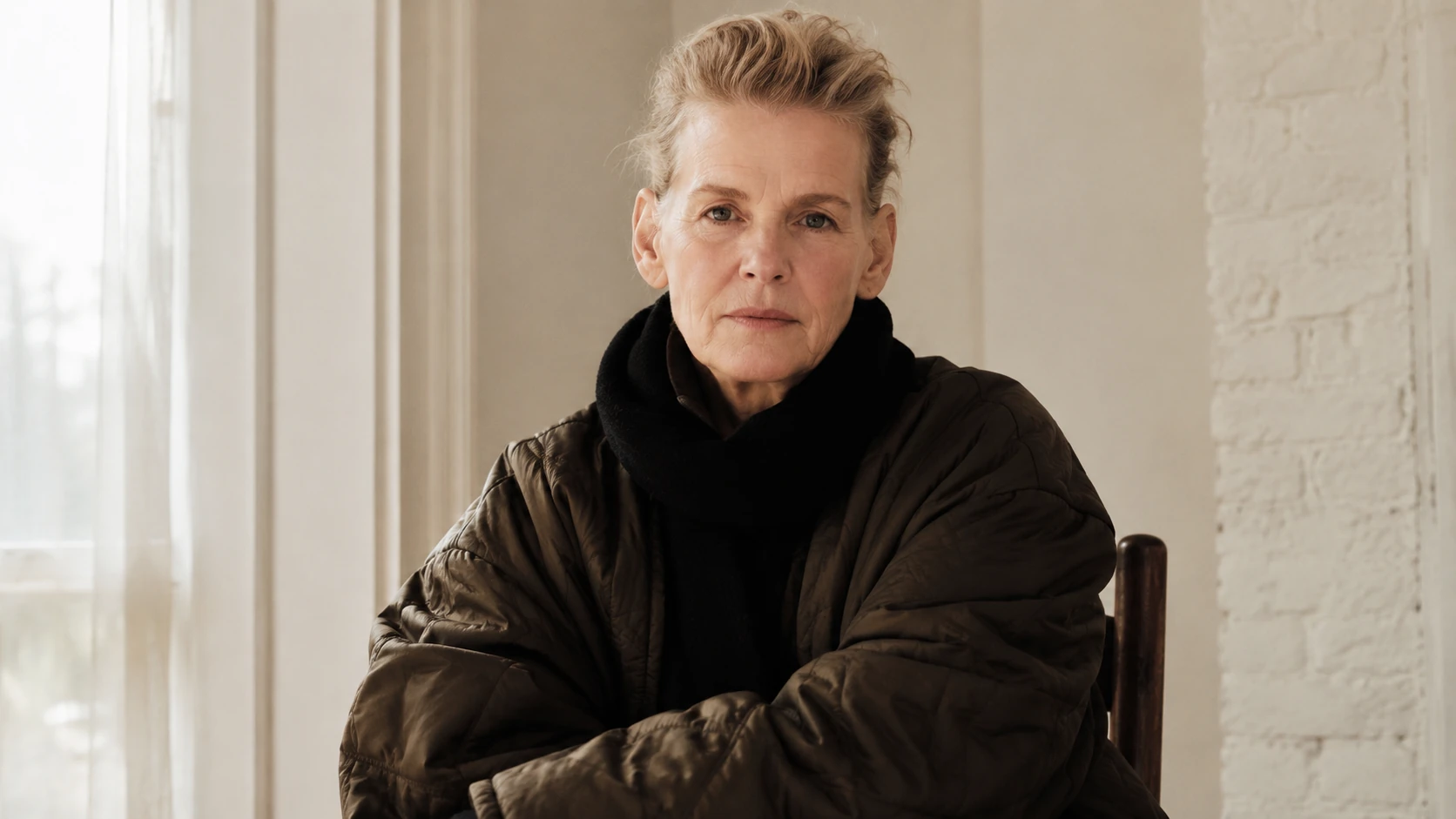
Jeny Howorth belongs to a rare class of models whose influence is not measured only by fame, magazine covers, or runway credits. Her name carries a particular charge in British fashion because she represented a look that felt sharp, intelligent, and modern long before that style became easy to describe. With her cropped blond hair, cool presence, and natural command of clothes, she became one of the faces associated with the more character-driven side of 1980s and 1990s fashion. She was never simply a mannequin for designers; she was a model with a point of view.
For many readers, Howorth’s name surfaces through i-D magazine, vintage fashion imagery, Helmut Lang references, or her daughter Georgia Howorth, who has also worked as a model. Others discover her through recent fashion campaigns that have brought older models and style originals back into the center of the frame. The public record around Jeny Howorth is not as heavily documented as it is for today’s social-media-era models, but the shape of her career is clear. She came out of London, entered fashion young, built a reputation through attitude as much as beauty, and remained part of the industry’s visual memory for decades.
Early Life and London Upbringing
Jeny Howorth grew up in Hampstead, one of North London’s most distinctive areas, known for its artistic history, village-like streets, and long association with writers, actors, designers, and creative families. Publicly available accounts of her early life describe a household that allowed room for independence rather than pushing her toward a rigid path. Her father has been described as an engineer, while her mother worked as a teacher. That background gives a useful glimpse into the kind of ordinary but open environment from which her later style emerged.
Howorth has spoken about being a visually experimental teenager, the kind of young person willing to change her hair and test out a look before fashion had formally given her permission. She was reportedly dyeing her hair green at a young age, which says more about her instincts than any polished résumé could. It suggests that her later fashion identity did not arrive entirely from stylists, photographers, or agencies. She already understood that appearance could be used as a form of self-definition.
Her route into modeling began in the late 1970s, when she was noticed in a Baker Street hairdresser in London. According to her own account in later interviews, the sister of someone connected to the salon ran a modeling agency, and that encounter helped open the door. This was a very different fashion world from the one young models enter now. There were no Instagram portfolios, no viral casting moments, and no instant global audience; a striking look seen in the right place could still change a person’s path.
Becoming a Model
Howorth entered modeling at a time when British fashion was changing quickly. The late 1970s and early 1980s brought punk, new wave, club culture, and street style into closer contact with magazines and designers. The old idea of the model as simply glamorous or conventionally pretty was starting to stretch. Editors, photographers, and stylists wanted faces that felt specific, urban, and alive.
That shift suited Howorth. Her look was not soft in the traditional sense, and that became part of her power. The cropped hair, fine features, and alert expression gave her photographs a dry, almost unsentimental quality. She could wear sharp tailoring, experimental styling, or classic clothes without losing her own identity inside the image.
Modeling also demanded more than looking interesting. A strong model has to understand posture, proportion, movement, and how clothing reads through a lens. Howorth has described learning from major photographers and developing a practical understanding of how to make clothes work in a photograph. That professionalism helped separate her from people who simply had a memorable face.
The Cropped Blond Look

One of the most recognizable parts of Jeny Howorth’s image is her short blond crop. The haircut became closely tied to her identity and has often been discussed in relation to the broader fashion history of androgynous beauty. It gave her an immediate visual signature, which mattered in an industry where a model’s silhouette and presence can be as important as facial beauty. The hair sharpened her look and made her feel contemporary even in images that are now decades old.
The crop also helped place Howorth within a lineage of models who challenged older feminine ideals. She did not need long hair, heavy glamour, or obvious sweetness to hold attention. Her appeal came from confidence, angles, restraint, and an almost casual refusal to perform prettiness in the expected way. That made her especially useful to magazines and designers interested in clothes that felt intelligent rather than decorative.
Her look has sometimes been compared to later cropped-haired models, but the better point is not who resembled whom. Howorth helped prove that a model could build an enduring image around character. The hair was a detail, but it also became a shorthand for a whole attitude: London, streetwise, controlled, and slightly rebellious.
Jeny Howorth and i-D Magazine
Jeny Howorth’s association with i-D magazine is central to her public story. Founded in 1980, i-D became one of the most influential British fashion and culture magazines of its generation. It was known for treating street style, youth culture, music, and fashion as connected forces rather than separate worlds. For a model like Howorth, who looked as if she belonged to real London life as much as to a studio, i-D was a natural fit.
Her appearance on the cover of i-D in the mid-1980s remains one of the clearest markers of her early fashion status. The magazine did not simply document clothes; it helped define a new kind of fashion person. Models in i-D often looked individual, imperfect in interesting ways, and connected to a living culture outside the studio. Howorth’s face and presence matched that editorial language.
What makes her i-D connection more interesting is that she was not only a subject in front of the camera. She later worked behind the camera as well, including photographic work connected to the magazine’s history. That move from model to image-maker matters because it shows that Howorth’s relationship with fashion was not passive. She understood pictures from both sides.
Work With Major Photographers
Howorth’s career brought her into contact with important photographers, including names associated with the highest levels of fashion imagery. Arthur Elgort and Steven Meisel are often mentioned in discussions of her career, and both represent different but serious traditions in fashion photography. Elgort’s work often brought movement, ease, and real-life feeling into fashion pictures. Meisel, by contrast, became known for sharp visual control, high drama, and an ability to define eras.
To work well with photographers at that level, a model needs more than good bone structure. She has to read the mood of a shoot, understand clothing, and make small physical decisions that strengthen the image. Howorth’s best work suggests that kind of intelligence. She did not overpower the clothes, but she did not disappear either.
There is a phrase sometimes used in fashion, the idea of being a great “clothes hanger.” Outside the industry, it may sound dismissive, but inside fashion it can mean something more exact. It refers to a model who understands how to let garments fall, move, and speak through the body. Howorth’s career shows that she had that skill.
Covers, Editorial Work and Runway Presence
Howorth’s modeling record includes covers, editorials, advertising work, and runway appearances. She is most closely associated with British and European fashion culture, but her work also touched American fashion magazines and international designers. Like many models from the pre-digital period, her full archive is not easy to reconstruct in one place. Still, the available record shows a career with real range.
She appeared in editorial settings that valued mood and styling rather than celebrity. That distinction is important because fashion modeling in the 1980s was not only about public recognition. Many important models shaped how clothes were remembered without becoming household names. Their images lived in magazines, designer lookbooks, advertising campaigns, and the memories of editors and stylists.
On the runway, Howorth’s value came from the same qualities visible in photographs. She could bring coolness without looking cold, and attitude without turning the clothes into costume. That made her a good fit for designers who wanted women to look modern, self-possessed, and not overly polished.
Helmut Lang and the 1990s Fashion Shift
One of the strongest later associations in Howorth’s career is with Helmut Lang’s fashion world. Lang’s work in the 1990s helped define a stripped-back, urban, intelligent style that moved away from excess. His casting often favored models with personality and distinctive presence, not just standard commercial beauty. Howorth fitted that world because she already carried the kind of restraint and character his clothes required.
The Helmut Lang model did not need to look like she was performing for applause. She could appear as if she had somewhere real to go, and the clothes were part of her life rather than a display. Howorth’s androgynous edge, compact haircut, and natural cool gave Lang’s tailoring and minimal pieces the right energy. She made the clothes feel worn, not staged.
This period also helped confirm her place among fashion insiders. Being linked with Lang’s model circle meant belonging to a group that helped shape the visual grammar of 1990s fashion. The style was spare, direct, and often more interested in attitude than decoration. Howorth’s presence made sense there because her whole career had already moved in that direction.
Family and Motherhood
Jeny Howorth’s family life is part of her public story, but it should be treated with care. She has children, and her daughter Georgia Howorth is the best-known publicly connected family member because she has also worked in modeling. Georgia’s career has brought renewed attention to Jeny, especially through features about model mothers and daughters. This intergenerational link has helped younger fashion readers discover Jeny’s earlier work.
Howorth has spoken about motherhood in a grounded way, suggesting that family life changed the rhythm of her career without fully ending it. That is an important distinction. Many female models from earlier generations were treated as if marriage or children marked the end of professional relevance. Howorth’s life shows a more realistic pattern: work, family, creativity, and fashion continued to overlap.
The relationship between Jeny and Georgia is also interesting because it reflects how fashion knowledge can pass through families. A mother who has stood in front of major photographers, worked with stylists, and understood casting from experience can offer a kind of practical education that no school can replicate. Georgia’s modeling career is her own, but it exists in conversation with a family history already tied to fashion.
Georgia Howorth and a Fashion Family Link
Georgia Howorth has been described in fashion media as a model with her own sharp look and connection to London’s fashion scene. She has appeared in magazines and has been discussed partly through the lens of her mother’s earlier i-D history. That framing can be limiting if it reduces Georgia to Jeny’s daughter, but it also says something true about fashion’s memory. The industry likes lineage, especially when the second generation carries a visible echo without copying the first.
Jeny’s connection to Georgia also softens the public view of her career. She is not only a striking archive image or a cool 1980s reference. She is a mother whose life continued beyond the moment fashion first noticed her. That gives her story more weight because it places her work inside a full adult life.
There is no need to overstate or sentimentalize that family connection. The most interesting point is simpler: Jeny Howorth helped define a visual attitude in one era, and her daughter entered a fashion world still interested in that attitude decades later. That kind of continuity is rare, and it explains why both names appear together in fashion conversations.
Art, Making and Creative Life Beyond Modeling
Howorth has described herself as a maker, and that word helps explain her life beyond conventional modeling credits. She has talked about sewing, making quilts, creating papier-mâché objects, cooking, and working with magazine images. These details matter because they show that her interest in visual culture did not end at the edge of a photograph. She appears to have carried a hands-on creative instinct into daily life.
That kind of making also fits her fashion identity. A good model often understands texture, weight, proportion, and color even if she is not formally designing the clothes. Howorth’s later creative work suggests that she was always alert to materials and surfaces. She was not only wearing images; she was thinking through them.
This part of her life may also explain why she has aged naturally within fashion rather than feeling like a figure frozen in one decade. People who keep making things tend to keep changing. Howorth’s public image today is not just nostalgia for the 1980s; it is the image of someone who has continued to live creatively.
Public Image and Industry Standing
Jeny Howorth’s public image has always been different from that of a mainstream celebrity. She has not built her profile around constant interviews, personal exposure, or public drama. Instead, her reputation rests on work, style, and the memory of people who follow fashion closely. That makes her a quieter figure, but not a minor one.
Fashion often preserves influence in ways the wider public does not immediately see. A haircut, a runway walk, a cover image, or a repeated casting choice can echo for decades. Howorth’s influence sits in that category. She is the kind of model stylists and editors remember because she represented a whole mood.
Her industry standing also benefits from the fact that she has not been overexposed. There is still some mystery around her, but not in a manufactured way. It comes from belonging to a pre-internet fashion era, when careers were documented through print, agency records, and personal memory rather than constant digital updates.
Net Worth and Income Sources
There is no reliable public record confirming Jeny Howorth’s exact net worth. Some websites may publish estimates for public figures, but those figures are often unsourced and should not be treated as fact. For a model whose career began before the modern influencer economy, income would have varied depending on editorial work, campaigns, runway jobs, agency agreements, and later creative projects. Without verified financial documents or direct reporting, any precise number would be guesswork.
Her known income sources likely included modeling assignments, magazine work, advertising campaigns, runway appearances, and creative work connected to photography or art. Established models can earn significantly from campaigns compared with editorials, but rates vary widely by era, market, agency, and brand. A model working in the 1980s and 1990s did not necessarily earn in the same way that a celebrity model or major social media personality might today. That difference is important when considering any online claim about wealth.
The most accurate way to describe Howorth’s financial status is that she built a long professional career in fashion rather than a publicly documented business empire. She has remained connected to high-level fashion work, including later campaigns and editorial attention. That suggests continued professional value, but it does not justify making firm claims about personal wealth.
Later Career and Return to Fashion Attention
In recent years, fashion has become more open to older models, archive figures, and women with visible life experience. Jeny Howorth fits that shift naturally because her appeal was never based only on youth. Her strongest qualities were always presence, character, and style. Those qualities often become stronger with age rather than weaker.
Her later appearances in fashion projects have introduced her to new readers who may not know the i-D or Helmut Lang context. For them, Howorth can appear first as a striking older model with a strong personal look. Learning the earlier story then makes the image richer. She is not a new discovery; she is a returning reference point.
This renewed attention also says something about how fashion is rethinking age. For years, the industry treated youth as almost the only currency. Now, at least in some editorial and luxury spaces, age can signal depth, credibility, and a life fully lived. Howorth benefits from that change because she never looked like someone trying to fit a generic mold.
Where Jeny Howorth Is Now
Jeny Howorth appears to remain connected to fashion, art, and creative work. She is publicly described not only as a model but also as an artist, which reflects the wider shape of her life. Her recent fashion presence shows that she has not vanished into archive status. Instead, she has become part of a more mature conversation about style, identity, and longevity.
She also remains connected to London’s fashion memory. Her story begins in Hampstead and Baker Street, moves through i-D, editorial work, major photographers, Helmut Lang, motherhood, and later creative projects. That arc gives her career a strong continuity even where exact records are incomplete. She represents a type of fashion life built through images, relationships, and personal taste rather than public confession.
For readers searching her name now, the most useful answer is this: Jeny Howorth is a British model and artist whose work helped define an intelligent, androgynous, character-rich strain of fashion beauty. She matters because her image lasted. She also matters because her career shows how a model can remain relevant without chasing celebrity.
Frequently Asked Questions
Who is Jeny Howorth?
Jeny Howorth is a British model and artist best known for her work in 1980s and 1990s fashion. She is associated with i-D magazine, major fashion photographers, Helmut Lang, and a distinctive cropped blond look that became part of her signature image. Her career has continued to draw attention because she represents a more individual, character-led kind of modeling.
She is also known as the mother of model Georgia Howorth. That family connection has brought fresh attention to Jeny’s earlier work, especially among readers interested in fashion lineage and model families. Still, Jeny had an established fashion career long before her daughter became publicly known.
What is Jeny Howorth famous for?
Jeny Howorth is famous for her distinctive look, especially her cropped blond hair and androgynous presence. She became known in fashion circles as a model who could give clothes attitude without overwhelming them. Her work with magazines and designers made her a recognizable figure in British fashion history.
She is also remembered for her connection to i-D magazine and the wider London fashion culture of the 1980s. Her influence is less about mass celebrity and more about visual identity. Many people who follow fashion archives recognize her as a model who helped define a certain cool, modern mood.
Is Jeny Howorth Georgia Howorth’s mother?
Yes, Jeny Howorth is publicly known as the mother of Georgia Howorth, who has also worked as a model. Their connection has been featured in fashion media because both women belong to the modeling world. It is one of the reasons Jeny’s name continues to appear in contemporary fashion discussions.
Georgia’s career should still be understood as separate from her mother’s. Jeny’s reputation was already established through her own modeling work, while Georgia entered fashion in a different era. Their shared profession creates a meaningful link, but it does not erase either woman’s individual identity.
Was Jeny Howorth an i-D model?
Yes, Jeny Howorth is strongly associated with i-D magazine. Her i-D cover in the 1980s is one of the most important public markers of her career. The magazine was closely tied to youth culture, street style, and a more individual approach to fashion, which suited Howorth’s image.
Her relationship with i-D also went beyond simply appearing as a model. She later worked behind the camera in connection with the magazine’s visual history. That adds depth to her profile because it shows her as someone engaged with image-making, not only modeling.
What is Jeny Howorth’s net worth?
Jeny Howorth’s exact net worth is not publicly confirmed by reliable sources. Any precise figure found online should be treated as an estimate unless it is backed by credible financial reporting. Models’ earnings can vary greatly depending on campaigns, editorial work, runway jobs, agency contracts, and the period in which they worked.
It is fair to say that Howorth built a long career in fashion and has continued to be valued by the industry. That does not mean there is enough public evidence to attach a specific fortune to her name. A careful biography should avoid inventing or repeating unsupported money claims.
Is Jeny Howorth still active in fashion?
Jeny Howorth appears to remain active in fashion and creative work. Recent attention around her has included later modeling projects and descriptions of her as both a model and artist. Her continued visibility reflects fashion’s growing interest in older models with history, personal style, and strong character.
Her current role is different from that of a young full-time model building a new career. She now carries decades of fashion memory into her work. That makes her valuable in a different way, especially for brands and publications that want presence rather than only youth.
Conclusion
Jeny Howorth’s biography is not the story of a celebrity who turned every part of her life into publicity. It is the story of a fashion original whose image traveled farther than her public persona. She emerged from London with a look that felt direct, modern, and slightly defiant, then built a career by understanding clothes as well as the camera.
Her life also shows how fashion influence can last without constant fame. A model can shape taste through a haircut, a walk, a cover, a campaign, or the memory of how she made clothes feel. Howorth’s name continues to matter because her style had that kind of staying power.
What makes her especially interesting now is the way her career bridges generations. She belongs to the i-D and Helmut Lang world of character-driven fashion, but she also fits the current appetite for older models who bring life experience into the frame. That gives her story present value, not just archive value.
Jeny Howorth remains a reminder that the strongest fashion figures are not always the loudest. Some leave their mark by looking entirely like themselves, and by making the industry adjust its idea of beauty around them.
