

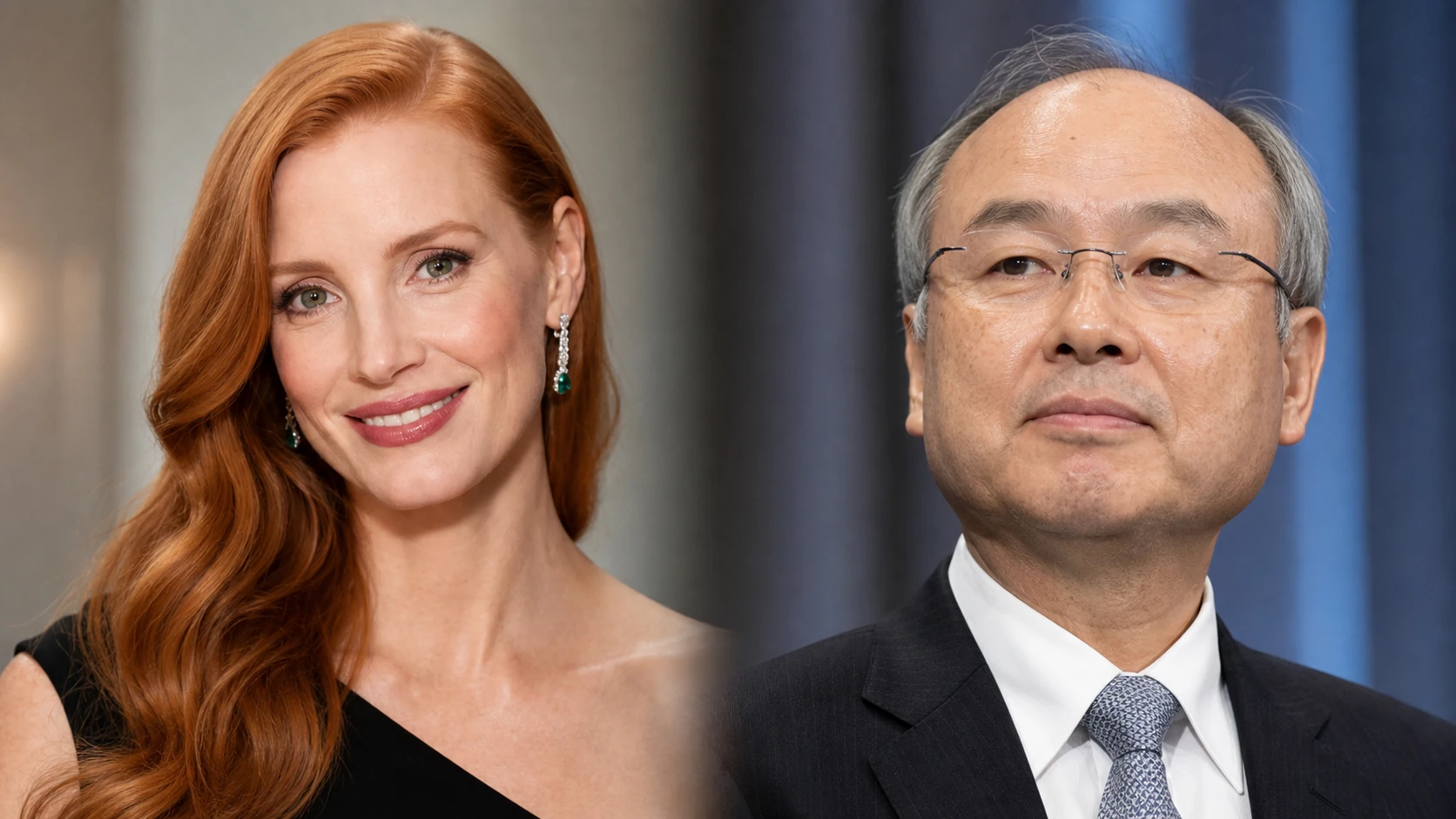
Jessica Chastain and Masayoshi Son have reached the highest levels of two very different professions. Chastain is an Academy Award-winning American actor and producer known for carefully chosen film, television, and stage roles. Son is the Japanese founder of SoftBank Group, whose investments in telecommunications, technology companies, semiconductors, and artificial intelligence have made him one of the world’s most closely watched business figures.
Their names are sometimes searched together, but there is no publicly confirmed family, romantic, or professional relationship between them. They have not announced a shared company, film, investment, charitable campaign, or public partnership. The most accurate way to understand the pairing is to examine their separate biographies and the very different forms of influence they represent.
Chastain’s story is rooted in acting training, persistence, production, and artistic recognition. Son’s story is built around entrepreneurship, financial risk, large technology investments, and a long-running belief that computing will reshape society. Both have built public identities around ambition, but their careers have developed independently.
Who Are Jessica Chastain and Masayoshi Son?
Jessica Michelle Chastain was born on March 24, 1977, in Sacramento, California. She is 49 years old as of July 2026. After training at the Juilliard School in New York City, she worked in theater and television before becoming one of the most respected film actors of her generation.
Masayoshi Son was born on August 11, 1957, in Tosu, Saga Prefecture, Japan. He is 68 years old as of July 2026. He founded the company that became SoftBank Group in 1981 and later expanded it from software distribution into telecommunications, investment management, semiconductor ownership, and artificial intelligence infrastructure.
Their public profiles differ sharply. Chastain is recognized through performances, awards, interviews, premieres, and production credits. Son is judged through acquisitions, investment returns, corporate strategy, market losses, financing decisions, and forecasts about the future of technology.
Is There a Connection Between Them?
No verified public evidence shows that Jessica Chastain and Masayoshi Son are personally or professionally connected. They are not known to be relatives, business partners, romantic partners, or collaborators.
There is also no confirmed record that SoftBank has invested directly in Chastain’s production company, Freckle Films. Chastain’s major film and television announcements do not identify Son or SoftBank as producers, financiers, or creative partners. SoftBank’s public investment announcements have likewise not identified Chastain as an adviser, spokesperson, founder, or investment recipient.
Their careers do touch the same broad public debate about artificial intelligence. Chastain has supported protections for actors whose compensation, employment, and digital likenesses may be affected by AI. Son has committed large amounts of capital to AI models, computing infrastructure, semiconductor technology, and data centers. That shared subject does not amount to a shared project.
Jessica Chastain’s Early Life and Education
Chastain grew up in Northern California and discovered an interest in performing at a young age. She has spoken about having a financially difficult childhood and about finding direction through the arts. Rather than entering the film industry through family connections, she developed her craft through local theater and formal training.
She attended Sacramento City College before gaining admission to the Juilliard School. A scholarship funded by Robin Williams helped support her education there. She graduated from Juilliard in 2003 with a Bachelor of Fine Arts degree.
Her training emphasized stage performance, discipline, voice, and character work. Those foundations remained visible throughout her later career, especially in roles that required controlled emotional expression rather than conventional celebrity glamour. Juilliard awarded her an honorary Doctor of Fine Arts degree in 2024.
Jessica Chastain’s Career Breakthrough
Chastain spent several years appearing in television programs and theater productions before receiving widespread film attention. Her early screen credits included appearances in series such as ER, Veronica Mars, and Law & Order: Trial by Jury. She also worked in stage productions, including adaptations of major classical works.

Her breakthrough arrived in 2011, when she appeared in several acclaimed films within a single year. These included The Tree of Life, Take Shelter, Coriolanus, and The Help. Her performance as Celia Foote in The Help earned her an Academy Award nomination for best supporting actress.
The rapid rise made her appear to be a sudden discovery, although she had already spent years training and working professionally. She followed that success with the role of CIA analyst Maya in Kathryn Bigelow’s Zero Dark Thirty. The performance brought her a second Academy Award nomination, this time for best actress.
Major Roles and Awards
Chastain became known for playing determined, intelligent, and emotionally guarded women. Her major films include A Most Violent Year, Interstellar, Crimson Peak, The Martian, Miss Sloane, Molly’s Game, It Chapter Two, and The Good Nurse. She has moved between studio productions, independent dramas, thrillers, science fiction, and historical stories.
She won the Academy Award for best actress for The Eyes of Tammy Faye, in which she portrayed American television evangelist Tammy Faye Bakker. Chastain also served as a producer on the film. Her performance required extensive physical transformation, but its impact depended more heavily on her effort to present Bakker as a complicated person rather than a caricature.
Television has become another major part of her work. She appeared opposite Oscar Isaac in Scenes from a Marriage and played country singer Tammy Wynette in George & Tammy. Her performance as Wynette earned strong reviews and added musical biography to an already varied career.
Chastain has maintained a close connection to theater. Her Broadway performance in a stripped-down revival of Henrik Ibsen’s A Doll’s House earned her a Tony Award nomination in 2023. The production relied heavily on voice, movement, and emotional restraint, reflecting the classical training that shaped her early career.
Freckle Films and Work as a Producer
Chastain founded Freckle Films in 2016. The company was created to develop projects with stronger opportunities for women and to support stories that established studios might overlook. It has allowed her to participate in decisions about scripts, directors, casting, financing, and production rather than working only as an actor for hire.
Her producer credits include projects in which she also appears on screen. This combination gives her more control over how female characters are written and presented. It also places her within the business side of entertainment, though her company remains far smaller than the multinational technology and investment organizations associated with Son.
Chastain has publicly supported workplace equality and fair treatment for performers. During the 2023 actors’ strike, she backed demands concerning pay, streaming compensation, and protection against the unapproved use of artificial intelligence. Her public image combines artistic seriousness with labor advocacy, though she usually avoids turning her private life into publicity.
Jessica Chastain’s Marriage and Family
Chastain married Italian fashion executive Gian Luca Passi de Preposulo in 2017. Their wedding took place in Italy after several years together. He comes from an Italian family with a long history, but the couple generally avoids extensive discussion of their home life.
They have children, though Chastain has kept most details about them private. She rarely shares identifying information or makes family life a central part of her public brand. This boundary has allowed her to maintain a visible international career while limiting public access to her children.
Claims about her family should be handled carefully because online profiles often repeat private or weakly sourced details. Her marriage is publicly documented, but the couple has not made every aspect of their household available for public reporting.
Jessica Chastain’s Net Worth and Income
Chastain earns money through acting salaries, production work, executive-producing agreements, theater appearances, and selected brand partnerships. Her income varies by project, and contracts for many films and streaming series are not publicly disclosed.
Celebrity finance websites publish different estimates of her net worth, but these figures are not verified financial statements. They may not account accurately for taxes, production investments, property, representation fees, business ownership, or private liabilities. It is safer to describe her as a financially successful actor and producer than to present a precise online estimate as fact.
Masayoshi Son’s Early Life and Education
Masayoshi Son was born into a Korean Japanese family in southwestern Japan. He has discussed experiencing discrimination during his youth because of his family background. His upbringing helped shape an unusually forceful approach to personal ambition and business identity.
As a teenager, Son moved to the United States and studied English. He later attended the University of California, Berkeley, where he studied economics and computer science-related subjects. While still a student, he pursued business ideas involving electronic translation devices and imported arcade machines.
These early ventures gave him capital and experience before he returned to Japan. In 1981, he established Nihon SoftBank as a software distribution company. The business began with a much narrower purpose than the global investment group SoftBank later became.
Building SoftBank
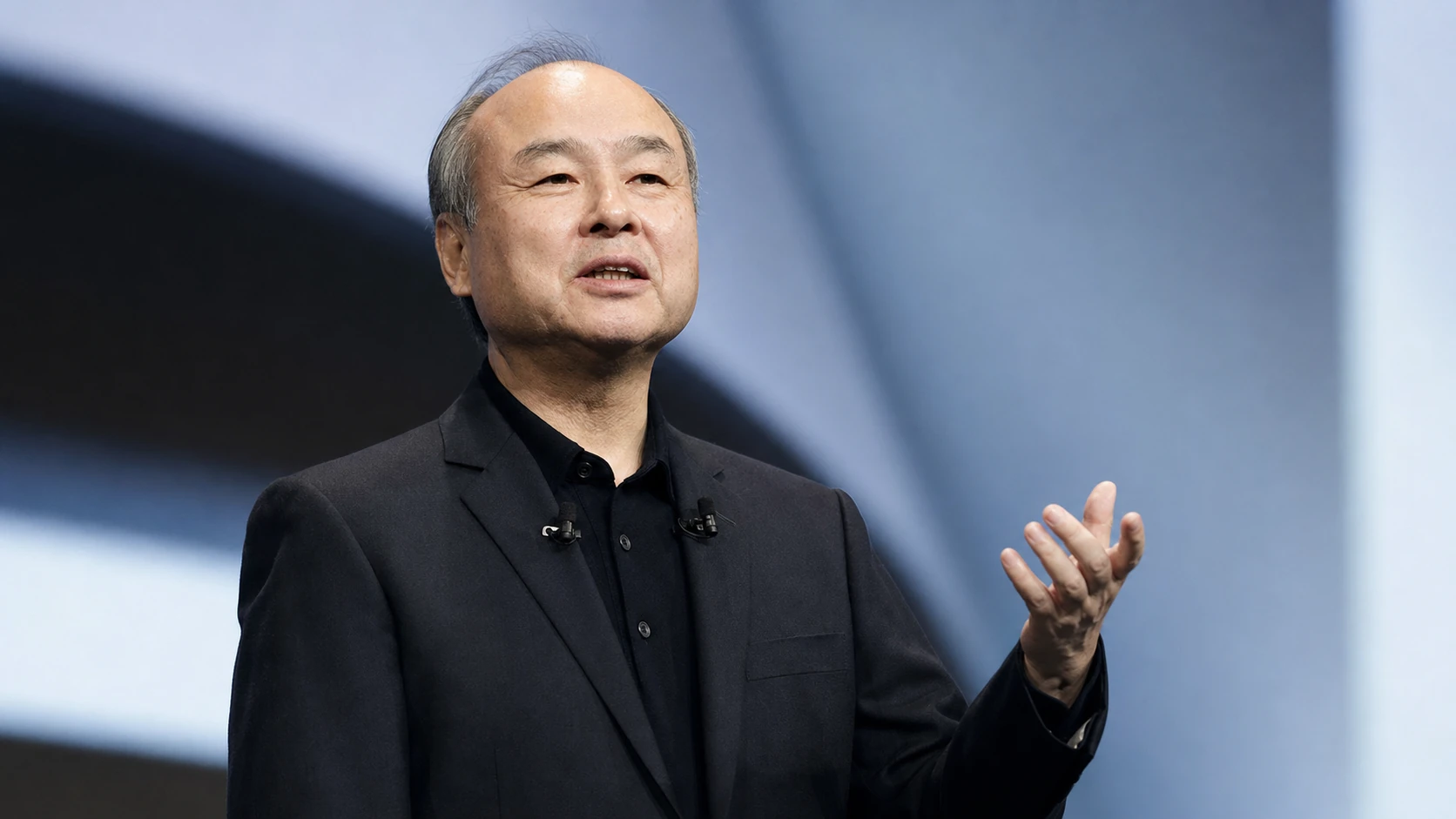
Son expanded SoftBank by moving early into personal computing, publishing, internet services, and telecommunications. He developed a reputation for acting on large predictions about where technology was heading. His willingness to commit capital before an industry became mature produced both exceptional gains and severe losses.
Building SoftBank
One of his most successful decisions was SoftBank’s early investment in the Chinese e-commerce company Alibaba. The investment grew dramatically as Alibaba became a global technology business. Its value gave SoftBank financial strength and established Son’s reputation as an investor capable of recognizing long-term potential.
SoftBank later entered Japanese mobile telecommunications and acquired major international assets. In 2016, it purchased British semiconductor designer Arm. Arm’s chip architecture is used across smartphones, computing devices, automotive systems, and data centers, making it central to SoftBank’s long-term technology plans.
The Vision Fund Era
Son launched the SoftBank Vision Fund as a huge investment vehicle focused on technology companies. The original fund was designed to reach approximately $100 billion with backing from SoftBank and outside investors. It made large investments in companies involved in transportation, property, financial technology, logistics, artificial intelligence, and online services.
The fund produced mixed results. Some investments increased in value, while others suffered steep losses. WeWork became the clearest symbol of the risks associated with SoftBank’s aggressive strategy after its valuation fell and its planned public offering collapsed in 2019.
Those setbacks damaged SoftBank’s financial results and raised questions about valuation practices, corporate governance, and Son’s reliance on founder-led growth stories. He responded by selling assets, reducing some exposures, and shifting the company’s focus toward Arm and artificial intelligence.
Masayoshi Son and Artificial Intelligence
By 2024, Son had placed artificial intelligence at the center of SoftBank’s future. He described the development of highly capable AI systems as a historic change that could affect nearly every industry. His strategy included investments in model developers, semiconductor companies, enterprise tools, robotics, and computing infrastructure.
SoftBank became a central participant in the Stargate Project announced in January 2025. The initiative involved SoftBank, OpenAI, Oracle, and MGX and proposed investment of up to $500 billion over four years in American AI infrastructure. Son was named chairman of the project, while SoftBank took responsibility for financial leadership.
SoftBank also announced major investment commitments involving OpenAI and enterprise AI services in Japan. These commitments were structured in stages and depended on financing arrangements and other conditions. They should not be read as a single payment already completed in full.
In 2026, SoftBank continued promoting large AI data-center plans, including proposed investment in France. Projects of this scale require electricity, land, chips, construction, financing, and sustained customer demand. Their eventual financial success will depend on execution over many years.
Masayoshi Son’s Family and Private Life
Son is married, but he has kept much of his family life outside his corporate public image. Details about his spouse, children, and household are far less visible than information about his investments and business decisions.
This separation is consistent with the way he presents himself publicly. Interviews and shareholder appearances usually focus on technology forecasts, investment strategy, SoftBank’s finances, and his personal ambitions for artificial intelligence. Reliable information about his relatives should not be expanded beyond what the family has chosen to make public.
Masayoshi Son’s Net Worth
Son’s wealth is tied largely to ownership interests in SoftBank and the changing market value of its assets. His estimated net worth can rise or fall sharply because SoftBank’s share price, Arm’s valuation, investment gains, debt, and currency movements change over time.
Financial publications provide current estimates based on publicly visible holdings, but those estimates are not fixed personal balance sheets. A precise figure may become outdated quickly. Son is clearly a billionaire, but any estimate should be dated and identified as an estimate rather than treated as permanent fact.
Their Public Images
Chastain’s public reputation rests on acting ability, serious preparation, selective privacy, and support for women in entertainment. She has moved between commercial films and difficult dramatic material without relying heavily on tabloid exposure. Her production work has also allowed her to influence which stories reach the screen.
Son’s reputation is far more divided. Supporters view him as a visionary investor willing to commit to technologies years before they become mainstream. Critics see a businessman whose confidence and scale can produce excessive valuations, unstable financing, and major losses.
Both figures are associated with risk, though the risks are different. Chastain risks artistic failure each time she takes on a demanding role or produces a film. Son risks billions of dollars on industries whose technology, regulation, and economics may change before his plans are completed.
Recent Work and Current Status
Chastain remained active across film, television, production, and theater-related work during 2024, 2025, and 2026. Her announced projects included the Apple TV series The Savant, in which she serves as star and executive producer, and The Off Weeks, a drama involving Ben Stiller. She also took a leading role in the horror film Other Mommy, scheduled for release in October 2026.
Son continued serving as SoftBank Group’s chairman and chief executive officer. His recent work centered on AI investment, Arm, OpenAI, Stargate, enterprise computing, and data-center construction. His current strategy represents one of the largest corporate bets on future demand for artificial intelligence.
No announcement during this period connected Chastain’s projects to Son or SoftBank. Their current activities reinforce the same conclusion as their earlier biographies: they are influential people operating in different industries without a confirmed shared venture.
Frequently Asked Questions
Are Jessica Chastain and Masayoshi Son related?
No. There is no credible public evidence that Jessica Chastain and Masayoshi Son are related. They were born in different countries, come from separate family backgrounds, and have independent careers.
Have Jessica Chastain and Masayoshi Son worked together?
No confirmed film, television, investment, business, or charitable project involving both has been announced. Neither Chastain’s production credits nor SoftBank’s public corporate releases identify a collaboration between them.
Did SoftBank invest in Jessica Chastain’s production company?
There is no publicly confirmed SoftBank investment in Freckle Films. A real investment would normally be supported by a company announcement, filing, or detailed report identifying the entities and financial structure.
How old is Jessica Chastain?
Jessica Chastain was born on March 24, 1977. She is 49 years old as of July 2026.
How old is Masayoshi Son?
Masayoshi Son was born on August 11, 1957. He is 68 years old as of July 2026 and will turn 69 in August 2026.
Is Jessica Chastain married?
Yes. Chastain married Gian Luca Passi de Preposulo in 2017. They have kept their marriage and children largely separate from her professional publicity.
What is Masayoshi Son doing now?
Son continues to lead SoftBank Group and focus on artificial intelligence, Arm, OpenAI-related investments, and large computing infrastructure projects. The results of these long-term commitments will depend on financing, construction, customer demand, and technology development.
Conclusion
Jessica Chastain and Masayoshi Son are linked mainly by an unusual search phrase rather than a documented relationship. Their biographies offer no confirmed family tie, romance, business partnership, or creative collaboration.
Chastain’s career shows the value of training, persistence, artistic judgment, and greater control over production. She has become a major actor without surrendering every part of her private life to public attention.
Son’s career reflects a different kind of ambition. He has repeatedly placed enormous financial bets on his expectations for the future, accepting public criticism and heavy losses alongside historic investment successes.
Their stories matter for separate reasons. Chastain represents creative achievement and the growing power of actors as producers, while Son represents the opportunities and dangers of investing at extraordinary scale. Until credible evidence establishes otherwise, they should be understood as two prominent figures whose paths have not publicly joined.
