

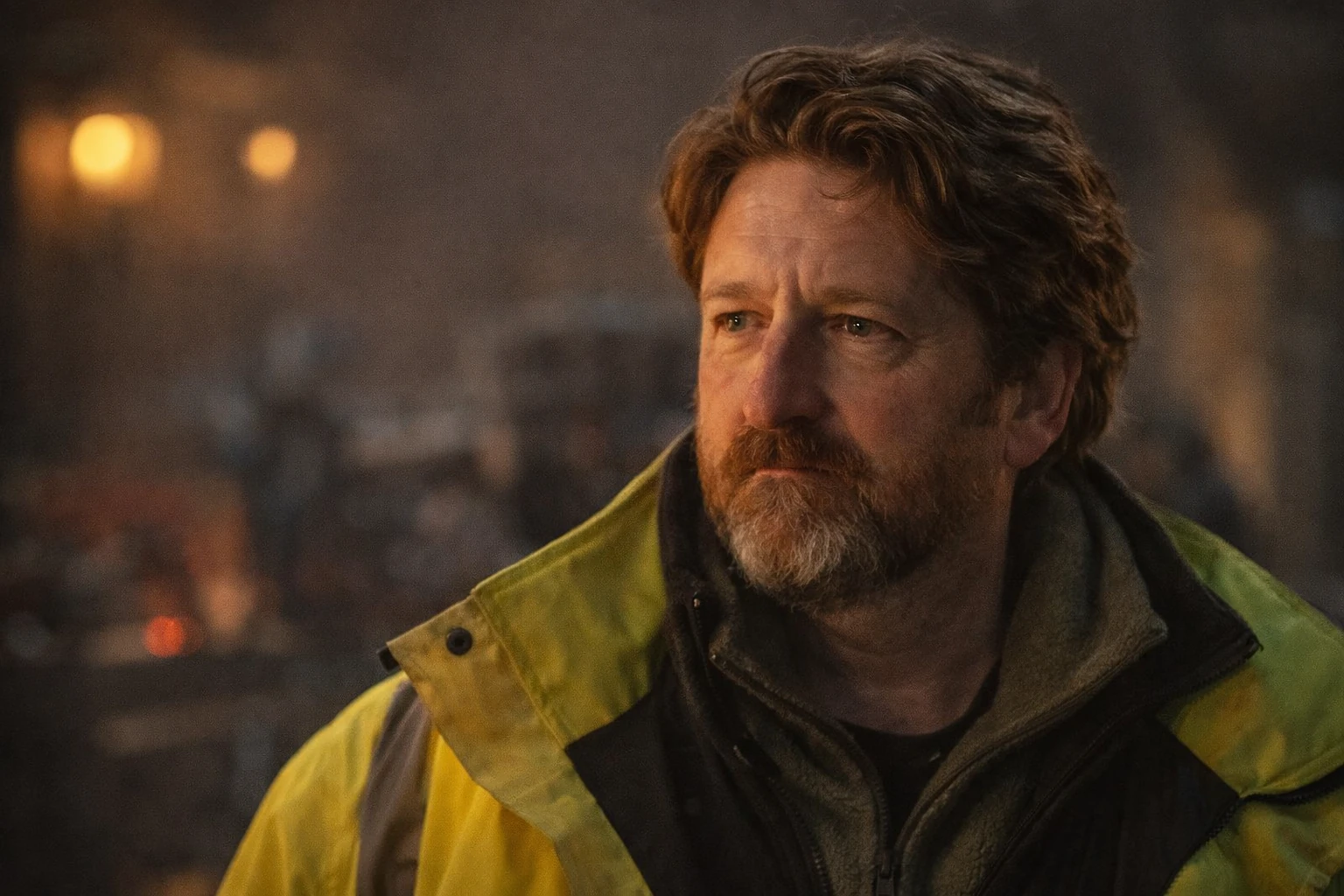
What you find when you follow that question isn’t a story of fame or headlines. It’s something steadier, and in many ways more revealing about how television actually gets made. Corbishley belonged to the part of the industry that keeps everything moving but rarely gets seen. His career lived in credits, not interviews, and in the respect of colleagues rather than public recognition. Yet by 2022, that quiet presence left a mark strong enough that two major British series chose to honor him on screen.
Early Life and Family Background
Public records about Kevin Corbishley’s early years are limited, which is often the case for crew members who spent their lives outside the spotlight. What can be confirmed is that he was born in 1965 in the United Kingdom, growing up during a period when British film and television were going through steady transformation. The 1970s and 1980s saw expanding production opportunities, especially in London and surrounding areas, where technical trades became vital to the industry’s growth.
Anyone who has spent time around British production crews will tell you that many careers in this field don’t begin in classrooms. They start through apprenticeships, hands-on work, and word-of-mouth introductions. By all accounts, Corbishley followed a similar path. While there’s no widely documented record of his schooling or formal training, his later work suggests a strong grounding in practical, technical craft that can only come from years on set.
The truth is, crew members like Corbishley often build their skills quietly, moving from smaller jobs to larger productions without much public trace. Family details remain private, and there’s no confirmed information about his parents or siblings in the public domain. That absence doesn’t signal a lack of story. It reflects a life lived outside media attention, where work mattered more than visibility and privacy remained intact.
Building a Career in Film and Television
Kevin Corbishley’s professional footprint becomes clearer once you look at his credits. He is associated with several well-known productions, including the 2012 film Anna Karenina, a visually ambitious adaptation that demanded precision in lighting and staging. Working on a project like that requires a high level of technical competence, especially in departments responsible for rigging and lighting support.
As a light rigger, Corbishley would have been part of the team responsible for setting up and maintaining the infrastructure that allows lighting crews to shape scenes. It’s physical work, often performed under tight deadlines, and it demands both safety awareness and problem-solving skill. If something goes wrong in that department, filming slows or stops entirely. If it goes right, nobody notices, and that’s usually the goal.
Over time, Corbishley became involved in television productions that reached wide audiences. His work on Call the Midwife, one of the BBC’s most enduring dramas, placed him inside a production known for its careful visual tone and period detail. That series relies heavily on consistent lighting and controlled environments, which means the rigging team plays a central role in maintaining its look across seasons.
Later, he joined the crew of Ghosts, a comedy series that gained a loyal following for its humor and warmth. Reports indicate he worked on the show from its second season onward. That timing matters, because it places him within the period when the series was finding its rhythm and expanding its audience. Working on a show like Ghosts requires flexibility, especially when dealing with location shooting in historic buildings where modern equipment must be carefully integrated without disrupting the setting.
Work on Ghosts and Call the Midwife
The connection between Kevin Corbishley and Ghosts became widely known after his death. The show’s fourth season premiere aired with a tribute card dedicated to him, referring to him as “our friend.” That choice of words spoke volumes. Television productions are collaborative environments, but not every colleague becomes “our friend” in a public message.
Radio Times reported that Corbishley died early in the production of season four, making the tribute both immediate and deeply felt. The cast and crew of Ghosts are known for their close working relationships, and the tone of the dedication reflected that culture. Viewers responded quickly, searching his name and trying to understand the person behind the tribute.
At roughly the same time, Call the Midwife aired its own memorial. The season 11 finale included a dedication reading, “In memory of Kev Corbishley: 1965 – 2022.” When a viewer asked about it on social media, the show’s official account replied that he was “a dearly loved member of our crew who died very recently.” That response confirmed what the tribute already suggested: his loss was personal to those who worked with him.
These two dedications, appearing across different shows in the same year, provide the clearest public insight into his reputation. They suggest not just competence, but character. In an industry where schedules are demanding and tempers can run high, being remembered with warmth says something real about how a person carried themselves day to day.
Personal Life and Relationships
Details about Kevin Corbishley’s personal life remain largely private. There is no confirmed public information about a spouse, children, or long-term partner. That might frustrate readers used to celebrity profiles filled with personal anecdotes, but it’s consistent with the way many crew members live. Their work keeps them moving between projects, often on long or irregular hours, and their personal lives stay out of the public record.
That said, the tributes from colleagues offer a glimpse into the relationships that mattered most. When a production describes someone as “a dearly loved member of our crew,” it suggests more than professional respect. It hints at daily interactions, shared challenges, and the kind of quiet support that keeps a set functioning smoothly.
Anyone who has worked on a film or television set knows that crews become temporary families. People spend long days together, often under pressure, solving problems in real time. In that environment, personality matters as much as skill. By all accounts, Corbishley was someone people valued not just for what he did, but for how he did it.
Financial Standing and Industry Recognition
Estimating Kevin Corbishley’s net worth isn’t straightforward, and no verified public figure exists. Crew members’ earnings vary widely depending on experience, union agreements, and the scale of productions they work on. A skilled light rigger on major British productions can earn a steady income, but it rarely translates into public wealth figures or celebrity-level financial disclosures.
The absence of awards tied to his name doesn’t diminish his contribution. Technical crew members often work behind the scenes without individual recognition, even when their work is essential to a production’s success. Industry awards tend to focus on directors, actors, and certain department heads, leaving many skilled professionals uncredited beyond the closing titles.
What Corbishley did receive, however, was a different kind of recognition. The on-screen tributes from Ghosts and Call the Midwife carry emotional weight that awards sometimes lack. They represent acknowledgment from the people who worked alongside him, which in many ways is the most meaningful form of recognition in a collaborative field.
Final Years and Passing in 2022
Kevin Corbishley passed away in 2022, though no publicly confirmed cause of death has been disclosed. That absence has led to speculation online, but responsible reporting stops at what is known. What is clear is that his death occurred during an active period in his career, with ongoing work on major television productions.
The timing of the tributes suggests that his passing was recent relative to the airing of those episodes. Productions typically include memorials shortly after a loss, especially when the individual was actively involved in current work. That immediacy adds to the sense that his absence was felt sharply by those around him.
There’s something understated about the way his passing entered public awareness. No press conference, no extended obituary in major headlines at the time. Just a line on screen, followed by a wave of viewers trying to fill in the blanks. In that sense, his story reached the public the same way his work did—quietly, but effectively.
Lesser-Known Details About Kevin Corbishley
Not many people know this, but Kevin Corbishley’s career reflects a broader pattern within British television, where long-term crew members often move between the same network of productions. Shows like Call the Midwife and Ghosts share overlapping talent pools behind the scenes, creating a tight-knit professional community. His involvement in both suggests he was part of that trusted circle.
Another detail that stands out is the consistency of his work across genres. Moving from a period drama like Call the Midwife to a comedy like Ghosts requires adaptability. Lighting demands differ, pacing changes, and each production has its own visual identity. That flexibility speaks to a level of expertise that isn’t always visible to audiences.
There’s also the fact that his name appears in connection with Anna Karenina, a film known for its stylized approach to staging and lighting. Working on such a production would have exposed him to complex technical setups, further sharpening his skills. That kind of experience tends to carry forward into later projects, influencing how a crew member approaches new challenges.
Perhaps the most telling detail, though, is how little of his life was documented publicly. In an age where many careers are built on visibility, Corbishley’s remained grounded in work itself. That choice, whether intentional or simply a result of his role, reflects a different way of moving through the industry—one focused on craft rather than recognition.
Frequently Asked Questions
Who was Kevin Corbishley?
Kevin Corbishley was a British film and television crew member known for his work as a light rigger and technical specialist. He contributed to productions including Ghosts, Call the Midwife, and Anna Karenina. His name became widely recognized after on-screen tributes in 2022. Those dedications reflected the respect and affection he earned within the industry.
What did Kevin Corbishley do for a living?
He worked behind the scenes in film and television, primarily in roles related to lighting and rigging. That job involves setting up equipment, ensuring safety, and helping create the visual atmosphere of a production. It’s demanding work that requires both technical skill and physical endurance. His contributions supported the overall look and feel of the shows he worked on.
Why did Ghosts dedicate an episode to him?
The dedication appeared because Corbishley was part of the show’s crew and passed away during the production period. The message referred to him as “our friend,” indicating a close bond with colleagues. Productions often include such tributes to honor team members who played an important role behind the scenes. It was both a professional acknowledgment and a personal farewell.
Did Kevin Corbishley work on other major productions?
Yes, his credits include work on Call the Midwife and the 2012 film Anna Karenina. These projects highlight his involvement in both television and film, across different genres. His ability to move between productions suggests a respected standing within the industry. That range is common among experienced crew members who build long careers behind the camera.
What is known about Kevin Corbishley’s personal life?
Very little has been publicly documented about his personal relationships or family. There are no confirmed reports about a spouse or children. This level of privacy is typical for crew members who work outside the public spotlight. His professional contributions remain the most visible part of his legacy.
Conclusion
Kevin Corbishley’s story doesn’t follow the usual arc of public figures. There are no red carpet moments, no headline-grabbing interviews, no carefully curated persona. What exists instead is a record of steady work and the respect of those who shared that work with him. In many ways, that’s a more honest portrait of how television is made.
The tributes from Ghosts and Call the Midwife didn’t turn him into a celebrity, and they weren’t meant to. They simply acknowledged that a valued member of the team was gone. For viewers, that acknowledgment opened a window into the unseen side of production, where countless individuals contribute to what ends up on screen.
What stays with you after learning about Kevin Corbishley isn’t a list of achievements. It’s the sense that he was someone people relied on, someone who showed up and did his job well, and someone whose absence was felt deeply. That kind of legacy doesn’t need embellishment to matter.
The next time credits roll at the end of a show, there’s a good chance you’ll read them differently. Names like his won’t feel like background anymore. They’ll feel like part of the story, which is exactly where they’ve always belonged.
