

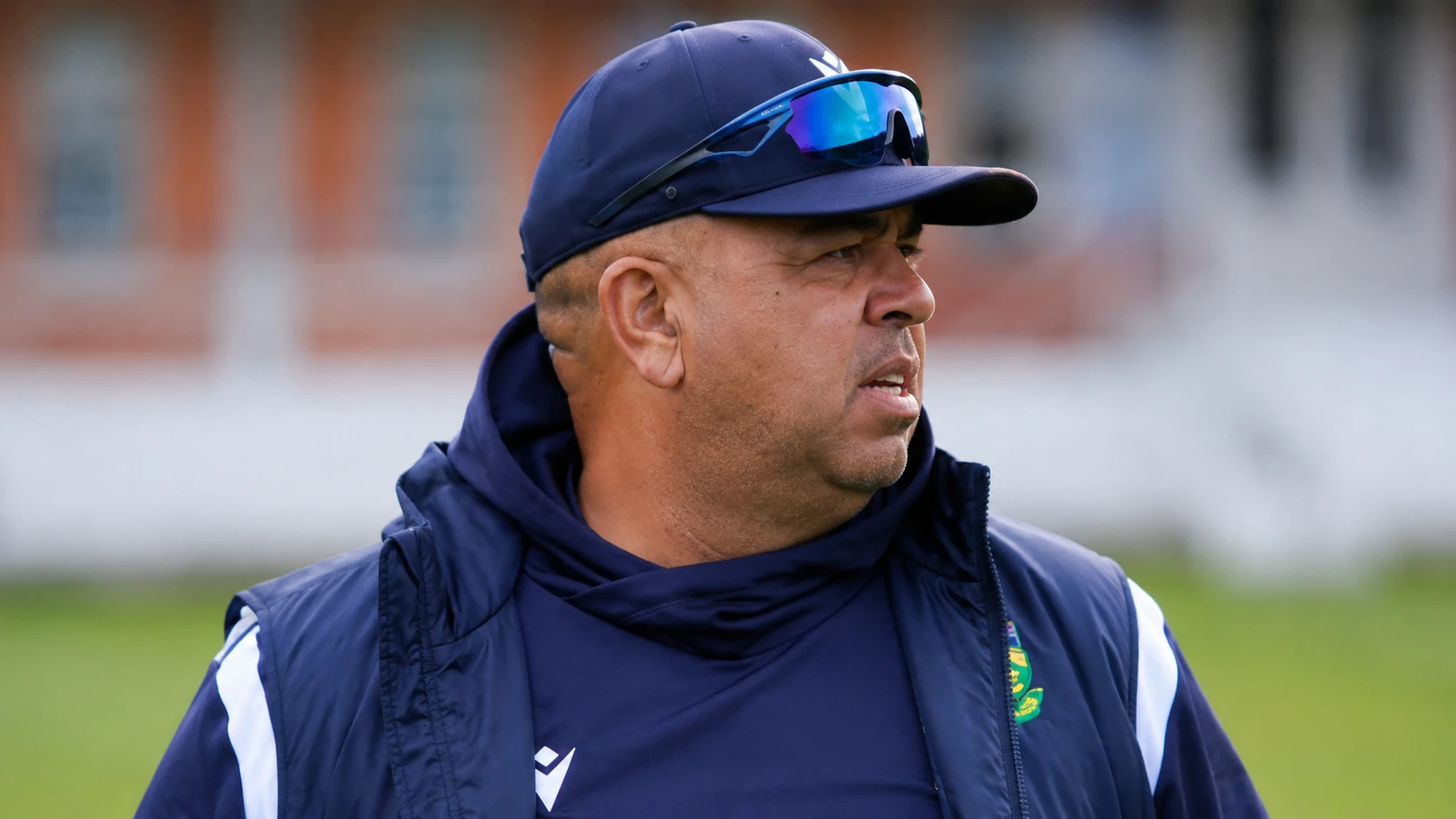
Shukri Conrad did not become one of South African cricket’s most important figures through a glittering international playing career. He became important the harder way, through domestic dressing rooms, development structures, difficult selection calls, and years spent working with players before the wider public knew their names. By the time he was handed South Africa’s Test team in 2023, he was already well known inside the country’s cricket system, even if casual fans were only beginning to ask who he was.
That question became louder after Conrad guided South Africa to the 2025 ICC World Test Championship title, one of the biggest achievements in the modern history of the Proteas men’s team. His rise matters because it says something about South African cricket itself: a country rich in talent, burdened by expectation, and often judged by its failures in global tournaments. Conrad’s story is not only about one coach. It is also about the long, patient work of turning promise into belief.
Early Life and Cape Town Roots
Shukri Conrad was born on April 2, 1967, in Lansdowne, Cape Town. His early cricket life was shaped by the Western Cape, a region with a deep and complicated sporting history. Cape Town cricket has produced players of style, toughness, and social meaning, and Conrad came through that environment before South Africa fully returned to international cricket after isolation.
Public information about his childhood, schooling, and private family background is limited. That is important to state clearly because Conrad has not made his personal life the center of his public profile. Unlike many modern sports figures, he is known mostly through his work, his teams, and his press-room comments rather than through family branding or social media exposure.
What can be said with confidence is that his cricket identity was formed in the Cape. He grew into the game as a player first, then as a coach who understood how talent can be missed, shaped, or wasted. That background would later matter because South African cricket has always needed coaches who understand both performance and opportunity.
Playing Career with Western Province
Conrad’s playing career was short and modest compared with the cricketers he would later coach. He played first-class cricket for Western Province and Western Province B between the mid-1980s and mid-1990s. He was a right-handed batter and a right-arm medium-pace bowler, the kind of all-round cricketer who had to earn his place through usefulness rather than fame.
His first-class record shows 14 matches, 524 runs, and 13 wickets. Those numbers do not suggest a player who was close to becoming a Test regular. They do, however, show someone who lived inside serious cricket, understood dressing-room pressure, and learned early how unforgiving the professional game can be.
That distinction matters because Conrad’s later authority did not come from international celebrity. He could not walk into a national dressing room and ask for respect because he had scored Test hundreds or taken five-wicket hauls at Lord’s. His authority had to come from clarity, honesty, planning, and the ability to make players better. In many ways, that made his coaching rise more interesting.
Moving Into Coaching
After his playing days, Conrad built his reputation in coaching rather than broadcasting, administration, or public commentary. He worked in South Africa’s domestic system, where reputations are formed slowly and usually away from bright lights. Coaches at that level deal with selection tension, limited resources, young players trying to break through, and senior players fighting for one more chance.
He coached Gauteng and later worked with the Cape Cobras, building a record that made him respected inside South African cricket. His teams won domestic titles, and he became known as a coach who could create structure without draining personality from a side. That is not always easy in cricket, where tactics matter but trust often decides whether a dressing room follows a coach.
The Cape Cobras period was especially important to his standing. The franchise was one of South Africa’s strongest domestic teams during that era, and success there placed Conrad among the country’s most credible coaches. He was no longer simply a former Western Province player. He had become a professional coach with evidence behind his name.
Development Work and the National Academy
Conrad’s career later moved into roles that were less visible to fans but highly important to the future of South African cricket. He worked with Cricket South Africa’s National Academy and also coached the South Africa Under-19 team. These jobs placed him close to the country’s next generation and gave him a clearer view of the gap between youth promise and senior international cricket.
Development coaching requires a different kind of patience from senior coaching. A national head coach is judged by wins and losses, but an academy coach is judged by whether players grow enough to handle the next level. That means working with technique, discipline, confidence, fitness, travel habits, and the mental shock of moving from local success to professional scrutiny.
This part of Conrad’s career helps explain why he later showed confidence in younger or less-settled players. He had spent years looking at cricketers before they became finished products. That background gave him a long view, which became useful when South Africa needed to rebuild confidence in Test cricket.
Uganda and a Wider Cricket Education
Conrad also had a spell as head coach of Uganda, an experience that took him outside South Africa’s better-resourced cricket structure. Coaching an associate nation can be demanding because the margins are thinner. Facilities, budgets, player depth, travel, and exposure are often more limited than in full-member systems.
That kind of job can sharpen a coach’s instincts. It forces practical thinking and strips away unnecessary theory. A coach has to understand what can be fixed now, what needs years, and which players can carry responsibility in conditions that are not always ideal.
Although Conrad’s Uganda period was not the defining chapter of his public career, it added range to his coaching education. He had seen cricket from different levels, not just from the comfort of a major domestic setup. Later, when he returned to South African structures, that wider view gave him another layer of experience.
Appointment as South Africa Test Coach
In January 2023, Cricket South Africa named Shukri Conrad as head coach of the Proteas men’s Test team. Rob Walter was appointed coach of the ODI and T20I sides, which created a split-coaching model for the national men’s team. Conrad’s assignment was clear: make South Africa a serious Test force again.
He inherited a side with world-class fast bowling, proud history, and major questions. South Africa had players such as Kagiso Rabada, Keshav Maharaj, Marco Jansen, Temba Bavuma, Aiden Markram, and others capable of beating anyone. But the team also faced limited Test fixtures, batting uncertainty, and the growing pull of T20 leagues.
Conrad’s job was not simply to motivate players. He had to give the Test side a plan that could survive pressure. South Africa needed clarity around selection, role definition, batting order, bowling balance, and leadership. The team had talent, but talent alone had not been enough.
Temba Bavuma and the Leadership Partnership
One of the central relationships in Conrad’s Test tenure was with Temba Bavuma. Bavuma had long carried a heavy public burden as South Africa’s captain, a senior batter, and a symbol in debates that were often larger than cricket. For Conrad, working with Bavuma meant supporting a leader who understood pressure as both a sporting and public experience.
Their partnership became important because the Test team needed calm. Bavuma’s style is not loud or theatrical, and Conrad’s best work has often come through directness rather than grand speeches. Together, they helped create a side that looked more settled in big moments than many South African teams of the past.
Bavuma’s role in the 2025 World Test Championship final later became part of that story. Injured but determined, he made a crucial fourth-innings contribution alongside Aiden Markram. That innings was not only about runs. It was about the trust between leadership, dressing room, and coach when the match was still very much alive.
Building a Test Identity
Conrad’s Test side became known for backing players with clear roles. One of the more discussed examples was Tristan Stubbs, who had first become widely known for white-ball power but was trusted in the demanding No. 3 position in Tests. That decision showed Conrad’s willingness to look beyond labels and judge a player’s wider game.
South Africa’s bowling strength gave the team a strong base. Rabada remained a high-class fast bowler, Jansen offered height and left-arm variation, and Maharaj brought control and experience as a spinner. The challenge was to support that attack with enough runs, enough patience, and enough tactical calm.
Conrad’s approach was not perfect, and no coach gets every call right. But his Test team began to look like a side with a clearer sense of itself. It did not depend only on aggression or tradition. It played with a growing belief that South Africa could still be a major country in the longest format.
The World Test Championship Triumph
The defining achievement of Conrad’s career came in June 2025, when South Africa beat Australia in the ICC World Test Championship final at Lord’s. It was a huge moment for the Proteas, not only because Australia were the opponents but because South African cricket had spent years carrying the weight of global tournament disappointment. The victory gave the country a senior men’s ICC title and changed the way Conrad’s tenure would be remembered.
The final was not straightforward. South Africa were bowled out cheaply in their first innings and could easily have faded under the pressure of the occasion. Instead, they stayed in the match through their bowlers and then produced a fourth-innings chase that demanded composure.
Aiden Markram’s century was the innings that defined the match, while Bavuma’s support gave the chase emotional force. For Conrad, the result validated years of work and months of belief-building. A coach who had never played Test cricket had led South Africa to a Test world title against one of the sport’s strongest nations.
Becoming All-Format Head Coach
In May 2025, Conrad’s job expanded when Cricket South Africa appointed him head coach of the Proteas men’s team across all formats. The move followed Rob Walter’s resignation from the white-ball role for personal reasons. It meant Conrad was no longer responsible only for Test cricket; he now had to guide South Africa in Tests, ODIs, and T20Is.
That appointment changed the scale of his career. Test coaching requires patience and long planning, while white-ball coaching demands faster adaptation, sharper matchups, and constant attention to player workloads. An all-format coach has to think about the whole calendar, not just one team sheet.
The 2027 ODI World Cup made the job even bigger. South Africa is one of the tournament’s co-hosts, which means expectation will be intense. Conrad’s task is to turn a strong group of players into a team that can handle home pressure, knockout cricket, and the country’s long history of painful near-misses.
Coaching Style and Personality
Conrad’s public style is direct. He does not speak like a coach trying to hide every feeling behind polished phrases. That can be refreshing, especially in a sport where interviews often become careful and dull. It can also be risky, because national coaches are judged not only by decisions but by every word they use.
Players often respond to coaches who are clear. Conrad’s strength appears to be his ability to set roles and make players understand why they are being backed. He is not a celebrity coach selling a personal brand. He is a working coach whose influence shows most clearly in selection trust, dressing-room belief, and tactical discipline.
But here’s the thing. The same directness that helps him can also create problems. In a country and sport with long memories, language matters. Conrad has had to learn that a strong phrase in a press conference can quickly become the story itself.
Setbacks and Public Scrutiny
Conrad’s tenure has not been free from criticism. One controversy came during South Africa’s Test series in India, when he used the word “grovel” while discussing South Africa’s approach. The term drew criticism because it carries painful cricket history, especially through Tony Greig’s infamous comment about the West Indies in 1976.
Conrad later acknowledged that he could have chosen a better word. That response did not erase the criticism, but it showed awareness that intent and impact are not always the same. For a national coach, especially one representing South Africa, public language is part of leadership.
On the field, white-ball cricket has also tested him. South Africa’s T20 and ODI sides have enough talent to beat elite teams, but global knockouts remain unforgiving. Conrad’s World Test Championship success gives him credibility, but it does not protect him from questions if white-ball campaigns fall short.
Family, Marriage, and Private Life
Shukri Conrad keeps his private life largely out of public view. There is limited verified public information about his marriage, children, or close family relationships. That does not mean those parts of his life are unimportant; it means they are not responsibly available for public biography beyond what has been confirmed.
Some profiles and cricket records connect him to Cape cricket family history, but detailed private claims should be treated carefully. Conrad has built his public identity through cricket work rather than personal exposure. That makes him different from many modern sports figures who share family life as part of their public image.
Readers often search for personal details because they want a fuller picture of the person behind the job. In Conrad’s case, the honest answer is that most of the reliable public record sits around his career. His private life appears to be just that: private.
Net Worth and Income Sources
There is no credible, officially confirmed public figure for Shukri Conrad’s net worth. Any exact number circulating online should be treated as an estimate unless it is backed by verified financial reporting or official disclosure. Coaches’ salaries in international cricket are rarely published in full detail, and private assets are not normally part of the public record.
His income sources are clear in broad terms. Conrad has earned money through professional coaching roles, domestic cricket work, national development positions, and his contract with Cricket South Africa. His current role as South Africa’s all-format head coach is likely the most senior and valuable position of his career.
That said, attaching a precise figure to his wealth would be misleading. A responsible estimate would need contract details, bonuses, endorsements, investments, property, and tax context, none of which are publicly confirmed in reliable detail. For readers, the more meaningful measure is his professional standing rather than an unsupported money claim.
Public Image and Reputation
Conrad’s public image has changed quickly since 2023. At first, he was seen by many casual fans as a domestic coach taking on a difficult Test assignment. After the World Test Championship win, he became the coach associated with one of South Africa’s most important cricket achievements.
Inside the sport, his reputation rests on experience and honesty. He is not presented as a tactical magician or a media-friendly superstar. He is seen more as a coach who understands the South African system, knows the players, and is willing to make hard calls.
There is still pressure on him to prove that Test success can translate across formats. South Africa’s supporters have heard many promises before, and one trophy does not remove every doubt. But Conrad has already shifted the conversation from whether he belonged in the role to how far he can take the team.
Where Shukri Conrad Is Now
Shukri Conrad is now South Africa’s men’s all-format head coach, responsible for guiding the Proteas through one of the most important periods in their recent history. His work includes protecting the gains made in Test cricket while preparing the ODI and T20I sides for major tournaments. The 2027 ODI World Cup is the clearest long-term target.
His immediate challenge is balance. He must manage senior players, develop younger options, handle injuries, and respond to the global pull of franchise cricket. South Africa’s best players are in demand around the world, and national planning has to account for fatigue, contracts, and shifting priorities.
What makes Conrad’s position fascinating is that he has already proved something important, yet still has much to prove. The World Test Championship win gave him a place in South African cricket history. The next question is whether he can turn that achievement into a broader era of consistency.
Frequently Asked Questions
Who is Shukri Conrad?
Shukri Conrad is a South African cricket coach and former first-class cricketer. He is best known as the Proteas men’s all-format head coach and the coach who led South Africa to the 2025 ICC World Test Championship title. Before his national role, he worked across South African domestic cricket, the National Academy, and the Under-19 setup.
How old is Shukri Conrad?
Shukri Conrad was born on April 2, 1967, in Lansdowne, Cape Town. That makes him 59 years old in 2026. His age also reflects the long path he took through playing, domestic coaching, development work, and finally the senior national job.
Did Shukri Conrad play cricket professionally?
Yes, Shukri Conrad played first-class cricket for Western Province and Western Province B. He was a right-handed batter and right-arm medium-pace bowler. His playing career was brief, with 14 first-class matches, but it gave him firsthand experience of the professional game before he moved into coaching.
Is Shukri Conrad married?
There is no widely verified public information about Shukri Conrad’s marriage or children. He has kept his private life away from regular media coverage. Because of that, responsible profiles should avoid making firm claims about his family unless those details are publicly confirmed.
What is Shukri Conrad’s net worth?
Shukri Conrad’s exact net worth is not publicly confirmed. Some websites may publish estimates, but those figures should be treated carefully unless they are supported by reliable financial reporting. His known income sources are his coaching roles, including his senior position with Cricket South Africa.
What is Shukri Conrad’s biggest achievement?
His biggest achievement so far is coaching South Africa to victory in the 2025 ICC World Test Championship final. The win over Australia at Lord’s was a major moment for the Proteas because it ended a long wait for a senior men’s ICC trophy. It also confirmed Conrad as one of the most important coaches in South African cricket.
What is Shukri Conrad doing now?
Shukri Conrad is serving as South Africa’s men’s all-format head coach. His role covers Test, ODI, and T20I cricket, with special attention on building toward the 2027 ODI World Cup. He is also responsible for keeping South Africa competitive in Test cricket after the World Test Championship success.
Conclusion
Shukri Conrad’s story is not built on instant fame. It is built on long service, quiet credibility, and the kind of cricket knowledge that comes from working across every level of the game. He moved from a modest first-class playing career into coaching, then spent years earning the trust that eventually placed him in charge of the Proteas.
His World Test Championship triumph changed his place in South African cricket. It gave him a defining achievement and gave the country proof that old patterns can be broken. That win did not make him untouchable, but it made his work impossible to dismiss.
The next chapter may decide how large his legacy becomes. If Conrad can guide South Africa toward sustained success across formats, especially with the 2027 World Cup ahead, he will be remembered as more than the coach of one great Test campaign. He will be remembered as the figure who helped South African cricket believe in its own nerve again.
