

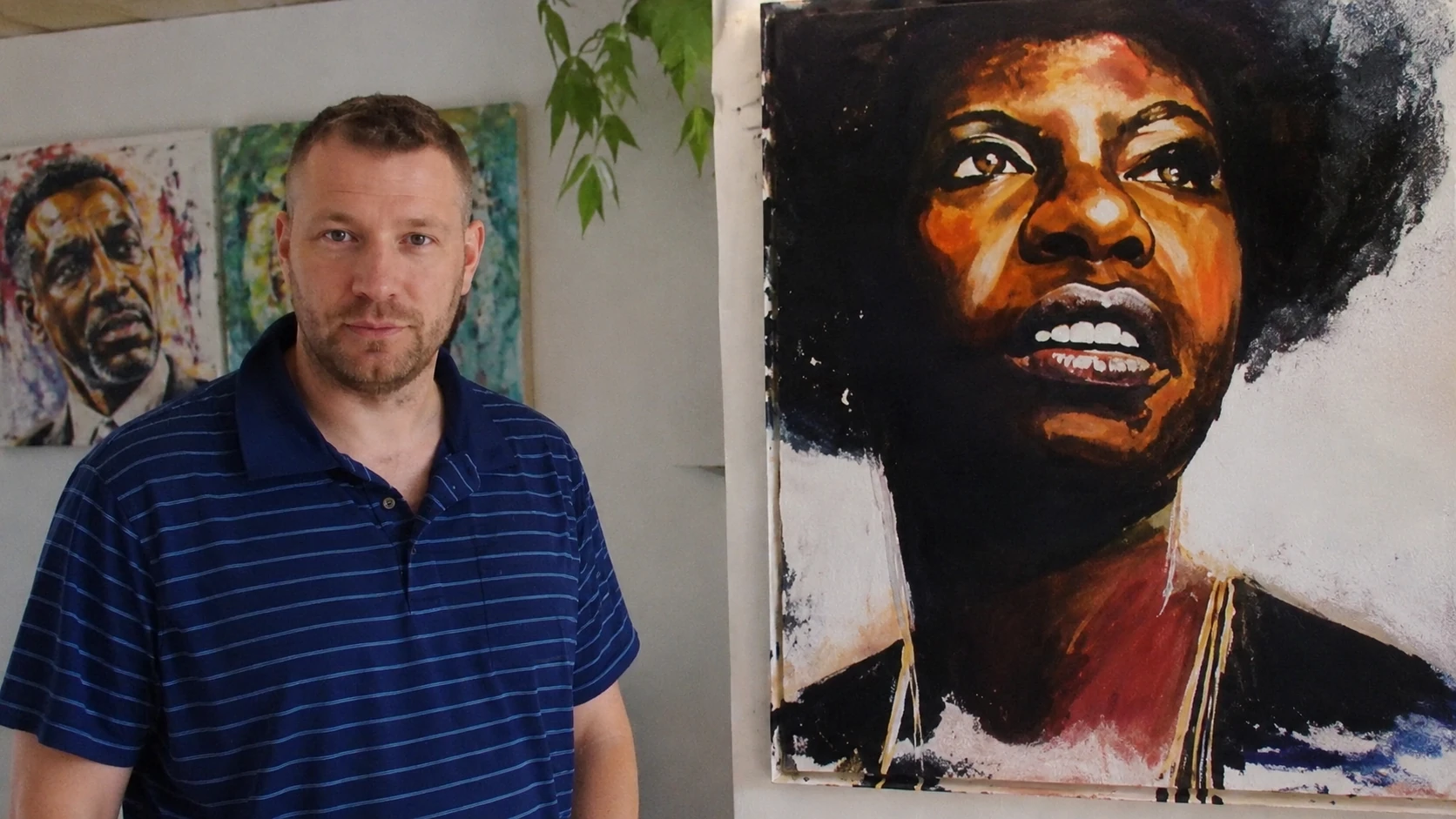
Jan Schiltmeijer has never seemed eager to turn his life into a public performance. For many readers, his name first appears beside Amber Ruffin’s, the comedian, writer, and television host who became one of late-night television’s most distinctive voices. But Schiltmeijer’s own story sits in a quieter register: a Dutch painter, raised in Amsterdam, trained in art direction, and drawn toward vivid portrait work rather than celebrity culture.
That contrast is part of why people search for him. He is connected to a famous former spouse, yet he has kept a far lower profile than the world around her. The available public record shows a man whose professional identity centers on visual art, especially acrylic and oil paintings built through layers of color and recognizable imagery.
There is also a reason to be careful. Schiltmeijer is not a celebrity who has given dozens of interviews, published a memoir, or lived his private life across entertainment pages. A responsible biography has to separate what is known from what is repeated without proof, especially on subjects like age, money, residence, family, and the private reasons behind a divorce.
Early Life and Dutch Background
Jan Schiltmeijer is publicly described as a Dutch artist who was born in Haarlem and raised in Amsterdam. Haarlem, a historic city west of Amsterdam, has long been associated with Dutch painting, printing, and design, though there is no public evidence that Schiltmeijer’s childhood was formally shaped by that heritage. What can be said with more confidence is that he grew up in a country where visual culture, graphic design, and painting have deep roots.
Details about his parents, siblings, and childhood home have not been widely confirmed in public sources. That privacy matters because many short biographies online try to fill gaps with guesses, turning missing information into false certainty. Schiltmeijer has shared enough to locate his early life geographically, but not enough to publish a detailed family history.
His upbringing in Amsterdam appears to have shaped the first part of his adult life. The city has a strong design culture, a lively arts scene, and a long tradition of international creative exchange. For a young person interested in images, performance, and visual communication, Amsterdam would have offered a broad field of influences without requiring an early move abroad.
Education and First Ambitions
Schiltmeijer’s known education points toward art direction rather than a traditional fine-art academy narrative. He has said publicly that he attended a specialized three-year course in art direction. That training suggests an early interest in composition, visual messaging, and the practical side of creative work.
Art direction is not the same as studio painting, but the two fields overlap in important ways. Both require a strong eye, control of mood, and an instinct for how an image lands with a viewer. In Schiltmeijer’s later paintings, especially his portrait and pop-culture subjects, that background helps explain the directness of his visual language.
After his studies, he worked in art direction for about two years. That stage appears to have been brief but formative, giving him a professional entry point into creative work. Rather than stay in a design-centered role, he chose to move toward painting full time, a decision that changed the public shape of his career.
Becoming a Full-Time Painter
Schiltmeijer dates his move into full-time painting to 2004. That date is one of the clearest markers in his career timeline, and it places his professional art practice well before his public association with Amber Ruffin. By the time many people later learned his name, he had already been painting for years.
His work has been described through layered acrylic technique, vivid color, and images designed to hold attention. Publicly visible examples of his portfolio include portraits and image-based paintings tied to familiar subjects, including figures from sports, film, and popular culture. The emphasis is less on quiet abstraction and more on bold recognition.
That kind of practice often lives outside the most visible art-world machinery. A painter can build a working career through direct commissions, private collectors, online presentation, and word-of-mouth without becoming a museum name. Schiltmeijer’s public footprint suggests that sort of independent artist’s path rather than a heavily documented gallery career.
Artistic Style and Subject Matter
Schiltmeijer’s paintings are best understood as accessible, image-forward works built around strong color and recognizable forms. His public portfolio has included pieces connected to Bruce Lee, Muhammad Ali, Abraham Lincoln, and other visually familiar subjects. These choices place him close to portraiture, fan memory, and the emotional charge people attach to public figures.
His stated layering method also gives the work a practical identity. Layering acrylic paint can create depth, contrast, and a sense of density that a flat image does not have. It is a technique well suited to portraits because the face depends on subtle transitions, even when the overall image feels bold and graphic.
The paintings appear designed for immediate impact. That does not mean they lack craft; it means they speak in a language many viewers can understand quickly. A viewer does not need a long critical essay to know why someone might want a vivid painting of Ali, Lee, or a favorite figure on a wall.
Public Recognition and Career Limits
Schiltmeijer’s public recognition is real, but it should not be overstated. He is not widely documented as a major institutional artist, and there is no strong public record of major museum acquisitions, large touring exhibitions, or top-tier auction history. The more careful description is that he is an independent Dutch painter with a public portfolio and a direct-facing art practice.
This distinction matters because online biography pages often inflate people connected to celebrities. A person becomes “famous” by association, and then vague claims about success, wealth, and influence follow. In Schiltmeijer’s case, the verified career story is more modest and more believable.
There is dignity in that modesty. Most working artists do not live inside headline-making careers, and many sustain their practice through private sales, commissions, and personal networks. Schiltmeijer’s available record fits that quieter model better than the dramatic career arc often imposed on celebrity-adjacent figures.
Meeting Amber Ruffin
Jan Schiltmeijer became more widely known because of his relationship with Amber Ruffin. Ruffin has publicly said that the two met in 2008, while both were connected to Amsterdam but happened to be in New York City. Their relationship began before Ruffin became a nationally recognized television writer and performer.
At the time, Ruffin was building a comedy career through performance, improv, and writing. She had worked in Amsterdam’s comedy scene, including the international improv and sketch environment around Boom Chicago. That shared Amsterdam chapter is an important part of how their lives crossed.
They married in 2010 after about two years of dating. The marriage later became part of Ruffin’s public story because she wrote and spoke about interracial marriage, racism, and what it meant for her white Dutch husband to witness how she was treated in the United States. For Schiltmeijer, those accounts remain some of the most detailed public references to his personal life.
Marriage, Race, and Life in America
Ruffin and Schiltmeijer moved to the United States after their marriage, including time in Los Angeles as Ruffin pursued comedy work. Their move placed the couple in a social setting very different from Amsterdam. Ruffin later described moments when Schiltmeijer saw, sometimes for the first time in a direct way, how racism shaped her daily life.
Those public reflections made their marriage more than a passing celebrity detail. Ruffin used the relationship to explain how two people in the same couple could experience the same country differently. Schiltmeijer, as she described him, had to learn not just from conversation but from watching what happened around them.
That public material should still be read with care. It offers Ruffin’s view of their marriage at a certain time, not a complete account of Schiltmeijer’s inner life. It shows him as part of an honest and sometimes painful conversation about race, but it does not turn him into a public commentator or activist in his own right.
Divorce and Current Relationship Status
Schiltmeijer and Ruffin’s marriage ended after more than a decade. Public reporting has stated that their divorce was finalized in December 2023. That means older descriptions of Schiltmeijer as Amber Ruffin’s husband are now out of date.
The reasons for the divorce have not been publicly explained in detail by both parties. That silence should be respected, especially because divorce is a private matter even when one person in the relationship is famous. There is no responsible basis for treating speculation as fact.
Ruffin later came out publicly as queer in 2024, and many readers encountered Schiltmeijer’s name again through coverage of that announcement. That update belongs primarily to Ruffin’s life and identity. It should not be used to make assumptions about Schiltmeijer or to rewrite the private history of their marriage.
Family and Private Life
There is no widely confirmed public record showing that Jan Schiltmeijer has children. Some online profiles make confident claims about personal details, but many do not point to reliable sourcing. In a biography of someone who has not chosen a high-publicity life, restraint is part of accuracy.
The same applies to his extended family. His parents, siblings, and close relatives are not part of a well-documented public record. Unless Schiltmeijer himself shares those details, or they appear in credible reporting, they should remain outside a serious profile.
What is clear is that he has kept his private life far quieter than the public life of his former spouse. That choice may be personal, professional, or simply natural for someone whose work is visual rather than performative. Either way, his low profile is one of the defining facts about him.
Money, Income Sources, and Net Worth
There is no credible public net worth figure for Jan Schiltmeijer. Estimates that appear on entertainment biography sites should be treated as guesses unless they are tied to verifiable sales records, contracts, property documents, or business filings. For an independent artist, income can vary widely from year to year, which makes neat figures even less reliable.
His likely income sources, based on the public record, are connected to painting and commissioned artwork. His portfolio includes original works, and his public-facing art presence suggests direct client contact has been part of his practice. That is a normal model for artists who sell outside large gallery systems.
It is also possible that his professional work has shifted or expanded over time, but the strongest public identity remains painter. Some recent online signals have connected his name to tattoo-related work, though that should be treated carefully without fuller confirmation. Until stronger evidence appears, any claim about a major career change should be framed as uncertain.
Public Image and Media Attention
Schiltmeijer’s public image is unusual because it is mostly indirect. He is searched because of Ruffin, but he is not known for seeking interviews, reality television, scandal coverage, or public commentary. That makes him visible enough to be discussed but private enough to be easily misrepresented.
The most common media framing calls him a Dutch painter and Amber Ruffin’s former husband. That description is accurate, but it is incomplete if it ignores his own creative work. A fuller portrait has to hold both truths at once: he is a working artist, and his public visibility grew through a high-profile relationship.
His quiet profile may also explain why incorrect or outdated information lingers. Once a low-publicity person is attached to a celebrity search term, old facts can be copied long after they change. The most important update for readers is that Schiltmeijer is no longer Ruffin’s husband and should not be described as such in current writing.
Where Jan Schiltmeijer Is Now
Jan Schiltmeijer’s exact current residence is not clearly confirmed in widely available public reporting. His artist biography has referred to being in New York, but personal websites are not always updated regularly. Other public-facing hints have connected him at times to Amsterdam, which would make sense given his Dutch background and creative roots.
What appears most stable is his artistic identity. His name remains tied to painting, especially portraits and layered acrylic or oil work. Even if his professional practice has changed in recent years, the public foundation of his career is still visual art.
There is a quiet lesson in that uncertainty. Not every person connected to a celebrity becomes a public figure in the full sense. Schiltmeijer’s current life appears to be partly private by design, and a serious biography has to leave space for what is not publicly known.
Why Jan Schiltmeijer Still Draws Interest
The continued interest in Jan Schiltmeijer comes from more than curiosity about a former celebrity marriage. His story touches several subjects people care about: art, cross-cultural relationships, interracial marriage, privacy, and the strange way fame can spill onto people who did not seek it. He sits at the edge of public life rather than the center of it.
Readers also search for him because Amber Ruffin’s career has kept growing. As her profile expanded through late-night television, comedy writing, theater, and public commentary, people naturally became curious about the person who was once closest to her private life. That curiosity is understandable, but it needs to be handled with respect.
The truth is, Schiltmeijer’s biography is not a tale of celebrity reinvention or public scandal. It is the story of a Dutch artist whose name became more visible through marriage, and whose own work remains rooted in images, color, and portraiture. That quieter story may be less sensational, but it is more accurate.
Frequently Asked Questions
Who is Jan Schiltmeijer?
Jan Schiltmeijer is a Dutch painter publicly known for layered acrylic and oil paintings, often centered on portraits and recognizable cultural figures. He was born in Haarlem and raised in Amsterdam, according to his own artist biography. Many readers also know him as Amber Ruffin’s former husband.
What is Jan Schiltmeijer famous for?
He is best known publicly for two reasons: his work as a painter and his former marriage to comedian and writer Amber Ruffin. His art career began before that relationship became public knowledge, but the marriage brought his name to a much wider audience. He has not built his public image through media appearances or celebrity promotion.
Is Jan Schiltmeijer still married to Amber Ruffin?
No, Jan Schiltmeijer and Amber Ruffin are no longer married. They married in 2010, and public reporting has stated that their divorce was finalized in December 2023. Current articles should describe him as Ruffin’s former husband, not her husband.
Does Jan Schiltmeijer have children?
There is no widely confirmed public evidence that Jan Schiltmeijer has children. Because he keeps much of his personal life private, claims about children or close family should be treated carefully unless supported by reliable reporting. A serious biography should avoid filling private gaps with guesses.
What is Jan Schiltmeijer’s net worth?
Jan Schiltmeijer’s net worth has not been credibly verified in public sources. Some websites may publish estimates, but those figures are not reliable without records of art sales, assets, contracts, or business income. The safest answer is that his income appears tied to his work as an artist, but no confirmed net worth is available.
Where is Jan Schiltmeijer from?
Jan Schiltmeijer is from the Netherlands. He has publicly described being born in Haarlem and growing up in Amsterdam. Those Dutch roots are central to the known early part of his life and career.
What kind of art does Jan Schiltmeijer make?
Schiltmeijer is known for vivid, layered paintings, including portraits and works based on recognizable public figures or strong visual subjects. His public portfolio has included pieces connected to film, sports, and cultural icons. His style is direct, colorful, and accessible to viewers outside formal art circles.
Conclusion
Jan Schiltmeijer’s public story is quieter than the search interest around his name might suggest. He is not a headline-driven celebrity or a person whose life has been fully documented in public. He is a Dutch artist whose work came first, and whose broader visibility grew through his former marriage to Amber Ruffin.
The most respectful way to understand him is to avoid turning limited facts into a dramatic myth. His known biography includes Haarlem, Amsterdam, art-direction training, a move into full-time painting in 2004, a long marriage that ended in 2023, and a continued association with visual art. Beyond that, much of his life remains private.
That privacy does not make him less interesting. It makes accuracy more important. Jan Schiltmeijer remains a figure at the edge of fame: close enough to be searched, private enough to be misunderstood, and defined most clearly by the art and choices he has made public.
