

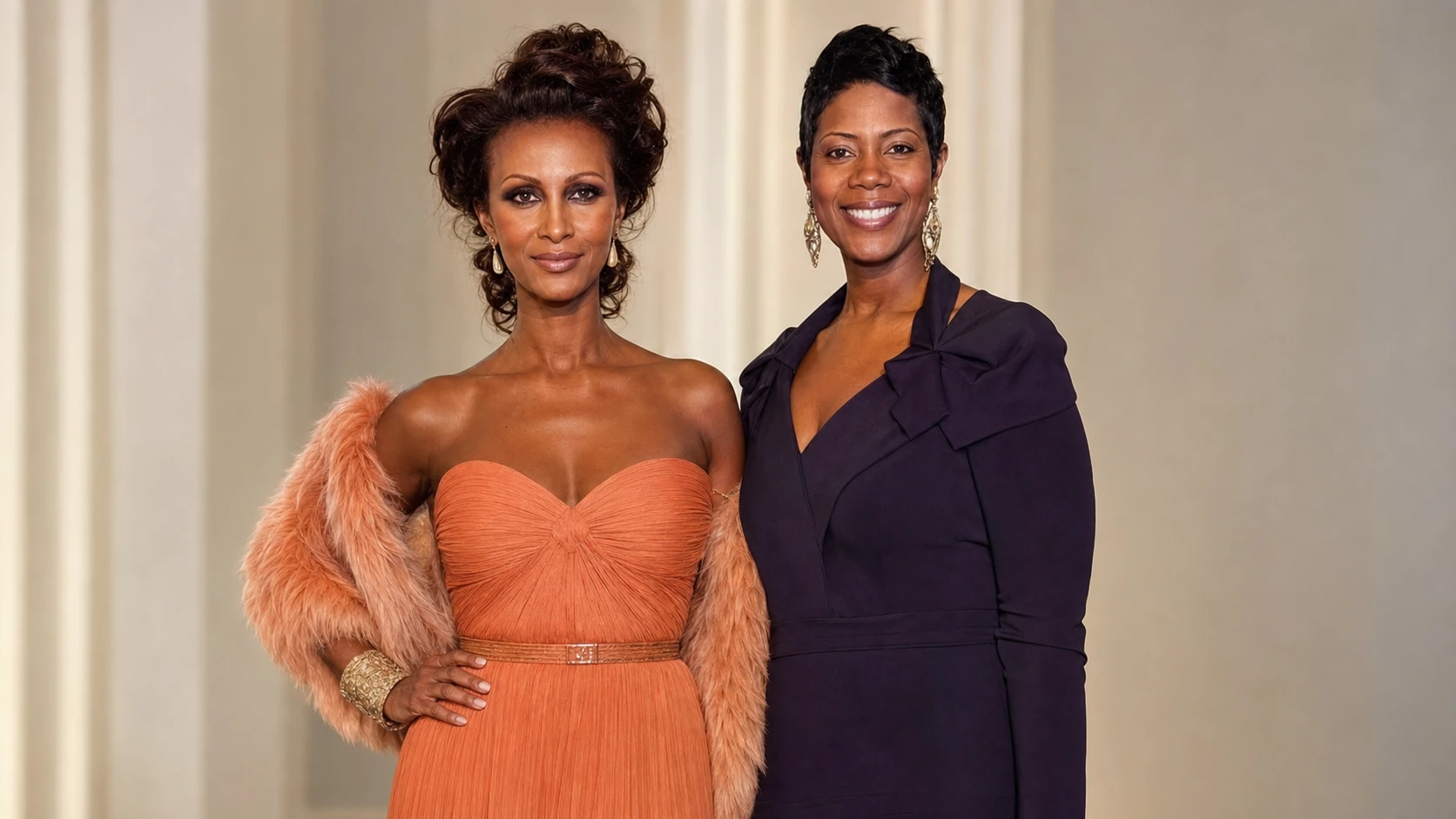
Zulekha Haywood is the daughter of model and entrepreneur Iman and Basketball Hall of Famer Spencer Haywood. Born in 1978, she grew up connected to two highly visible worlds—international fashion and professional basketball—but has largely built her adult life away from celebrity culture.
Public information about Haywood is relatively limited, and that distinction matters. Much of what circulates online about her exact birthday, education, marriage, net worth and current employment comes from secondary biography sites rather than strong primary records. The clearest picture of her comes instead from her own writing, her mother’s interviews and reputable reporting about the family.
Her most significant public contribution is a 2010 first-person essay for Glamour in which she discussed childhood body-image pressures, serious health concerns, gastric-bypass surgery and the broader question of how women learn to measure their worth. That essay provides a more substantial understanding of Haywood than the celebrity-family facts that usually introduce her.
Growing up between fashion and professional basketball
Haywood was born in 1978 to Iman and Spencer Haywood. Her mother became one of the most influential models of her generation and later built a cosmetics business, while her father had a major professional basketball career and was inducted into the Naismith Memorial Basketball Hall of Fame in 2015.

Spencer Haywood’s career also carried historical significance beyond his playing record. He was the leading scorer for the United States team that won basketball gold at the 1968 Olympics and later challenged NBA eligibility restrictions in a case that helped change the league’s rules for younger players.
For Zulekha, however, having accomplished parents was not simply a matter of prestige. In her later writing, she described growing up conscious of the contrast between the qualities associated with them publicly: her mother’s beauty and fashion career on one side, and her father’s elite athleticism on the other.
Iman has recalled that Zulekha traveled with her while she worked when her daughter was very young. In a 2022 Glamour interview, Iman described Zulekha as her oldest daughter and said she took her along until she reached school age.
That early proximity to the fashion industry would later become relevant to Haywood’s own account of how she thought about appearance.
The body-image story Haywood chose to tell publicly
The most detailed first-person record of Zulekha Haywood’s life appeared in Glamour in March 2010.

In the essay, Haywood wrote that concerns about her weight began early. She said she had been dieting from about the age of eight and described growing up feeling physically unlike both of her parents. Her mother’s career made beauty a highly visible part of the family’s public identity, while her father’s athletic background represented another physical ideal.
Haywood’s account did not present those contrasts simply as family trivia. She used them to explain the pressures she experienced around her own body and the way weight became tied to how she understood herself.
By adulthood, she wrote, the issue had become a health problem as well as an emotional one. At 28, she reported experiencing heel spurs, painful and swollen knees, osteoarthritis and high blood pressure. She sought medical advice and, after testing and counseling, chose bariatric surgery.
The procedure she identified was Roux-en-Y gastric bypass. That distinction is worth preserving because some later online profiles have inaccurately described her treatment as a gastric band procedure.
Surgery, complications and recovery
Haywood wrote that the operation was followed by serious complications. According to her account, she required intensive-care treatment and a second operation soon after the initial procedure.
She later recovered and said she returned to work roughly a month afterward. Over the following 18 months, she reported substantial weight loss. The figures she gave in the 2010 essay describe that historical period and should not be treated as present-day measurements.
More important than the numbers was the conclusion she drew from the experience.
Haywood’s essay was not ultimately an argument that losing weight had solved the question of self-worth. Instead, she challenged the idea that a woman’s value should be determined by her size or appearance. She also pushed back against the assumption that being attractive should naturally lead a woman toward modeling—a particularly meaningful point given her mother’s profession.
The essay therefore stands as more than a personal account of surgery. It is the clearest example of Haywood speaking publicly in her own voice about identity, appearance and the expectations that can accompany a famous family name.
A business career kept largely private
Unlike her parents, Haywood has not built a career around public performance or celebrity.
Secondary profiles have consistently described her as working in business analysis, accounting, planning and related corporate roles. Several have linked part of her professional history to Iman Cosmetics, the beauty company associated with her mother.
Some later biographies also list positions or associations involving other companies, but the public documentation is uneven. No strong, accessible primary employment record was identified that would justify presenting a detailed job-by-job chronology—or a specific current employer—as settled fact.
The safest conclusion is that Haywood has pursued a corporate business career, including reported work connected with Iman Cosmetics, while keeping most of her professional life outside mainstream media coverage.
That relative privacy is consistent with the broader pattern of her public life. She is not known for maintaining a celebrity profile of her own, and there is little reliable evidence of an effort to turn her family connections into a public-facing personal brand.
What is reliably known about Zulekha Haywood today
The strongest recent reporting continues to describe Haywood as living largely outside the spotlight.
A People article updated in February 2026 identified her as Iman and Spencer Haywood’s daughter, confirmed her 1978 birth year and characterized her as comparatively private. The publication noted that she shares limited glimpses of areas such as family life, food and travel, rather than maintaining the kind of highly public professional presence associated with her parents.
That limited public record also means some frequently repeated details about Haywood should be treated carefully.
An exact July 5 birthday is widely reported by secondary biography sites, but stronger sources reviewed for her profile confirm only the year 1978. Claims about her schooling and university education are similarly repeated without sufficiently authoritative documentation. Detailed assertions about her spouse, children, present employer and personal finances are also too weakly sourced to present confidently.
Net-worth estimates in particular should be avoided. Figures circulating online are not supported by credible financial disclosures or authoritative reporting.
The same caution applies to current height or weight claims. Numbers drawn from Haywood’s 2010 discussion of her post-surgery experience describe a specific historical moment and are not evidence of her present measurements.
A public identity that is not defined only by famous parents
Zulekha Haywood will inevitably be introduced through Iman and Spencer Haywood because their prominence explains why many readers recognize her name. Yet the most revealing evidence about her comes from the moments when she stepped outside that inherited public identity.
Her 2010 essay offered a personal account of what it meant to grow up with beauty and athletic achievement as highly visible reference points, to struggle with her own health and body image, and eventually to reject the idea that physical appearance should determine personal value.
That perspective gives her public profile its substance. Rather than following her mother into modeling or her father into sport, Haywood appears to have chosen a substantially more private path, including a reported career in business.
Final thoughts
Zulekha Haywood is best understood not simply as Iman’s daughter or Spencer Haywood’s daughter, but as someone who has mostly remained outside celebrity life while making one notably candid contribution to public discussion about body image, health and self-worth.
Her public record is not extensive, and a responsible biography should not pretend otherwise. What can be said with confidence is that she was born in 1978, grew up between two exceptionally visible professional worlds, pursued business work away from the spotlight and used her own voice in Glamour to challenge the idea that a woman’s value can be reduced to her appearance.
